
Bring your own carrier for AI voice agents








What bring your own carrier actually means
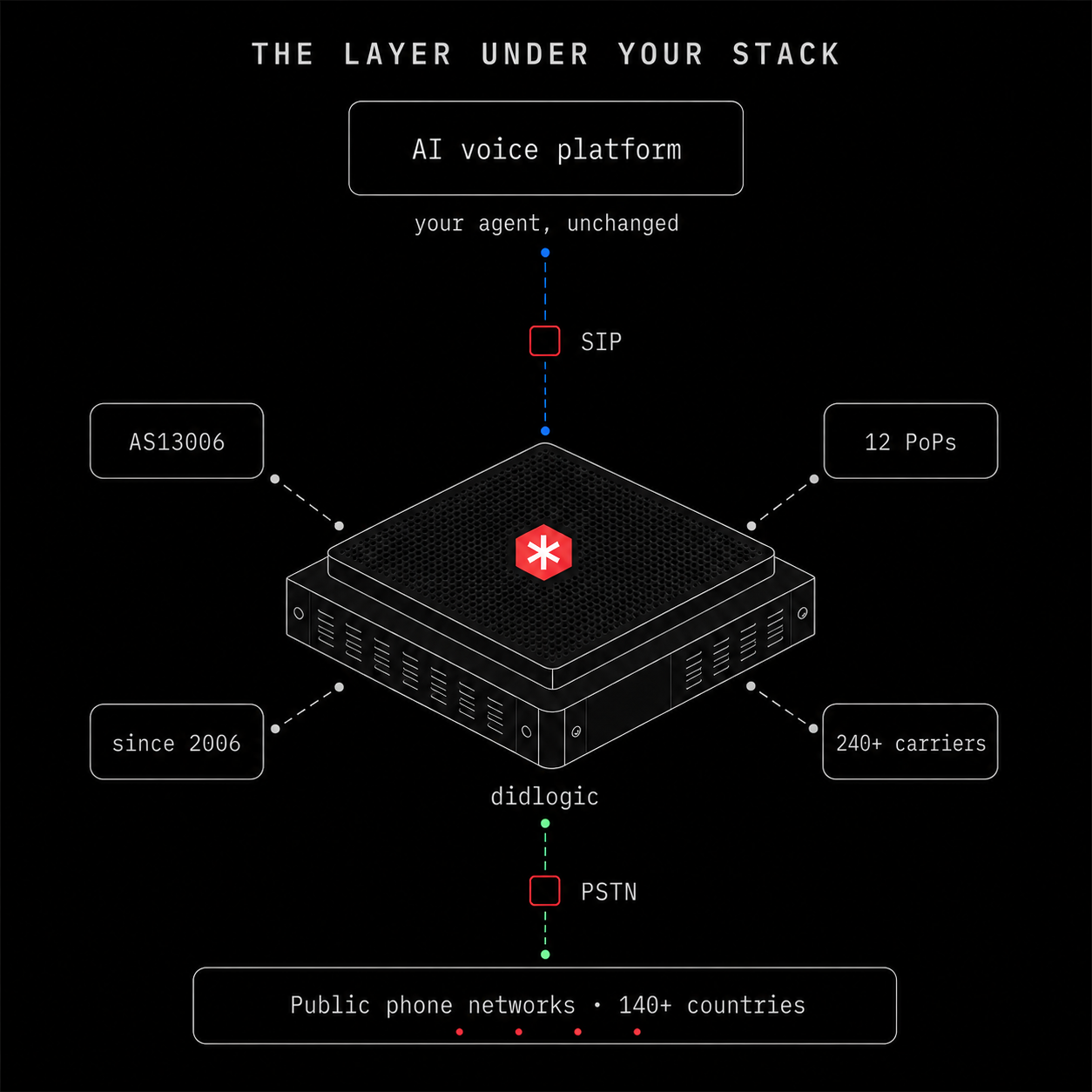
A voice AI platform does two different jobs. It runs the agent: the models, the prompts, the tools, the call logic. And it puts the call on the phone network: the SIP trunk, the carrier interconnects, the numbers.
Those two jobs get sold together by default. Bring your own carrier separates them. You keep the platform for the agent and connect it to a SIP trunk you control, usually through a setting called BYO SIP Trunk, Custom Telephony or Elastic SIP.
Nothing about your agent changes. The prompts, the tools, the workflows and the model choice all stay where they are. What changes is which network the audio travels over, whose numbers you are using, and who bills you for the minutes.
didlogic only does the second layer. We have been carrying voice since 2006 on our own Autonomous System, AS13006, across 12 physical points of presence and around 240 direct carrier agreements. We do not build agent platforms, so nothing we sell competes with what you built.
Why teams move the carrier layer
Bundled telephony is resold. You are paying the platform’s margin on top of a carrier’s rate. On test traffic that is invisible. On production traffic it is usually the largest line on the bill after the models.
A number provisioned inside a platform belongs to that account. A number on your own carrier account is yours, and it moves with you if you change platforms, run two platforms at once, or bring the workload in house.
Most platform-managed number pools are heavily US-weighted. If your callers are in Europe, the Gulf, Latin America or Southeast Asia, the carrier layer is usually where you run out of road first.
When answer rates drop in one country, you need a carrier who will look at the route with you. That conversation is hard to have through a platform’s support queue.
| Platform | BYOC method | Setup guide |
|---|---|---|
| Vapi | BYO SIP Trunk | Vapi setup |
| Retell | Custom telephony (SIP) | Retell setup |
| ElevenLabs | SIP trunk, inbound and outbound | ElevenLabs setup |
| LiveKit | SIP trunk, inbound and outbound | LiveKit setup |
| Anything else that speaks SIP | Termination URI or custom trunk | All setup guides |
Three steps to a live call
-
Step 1
Buy a number
Pick a local or toll-free number in the didlogic portal, in whichever market your callers are in.
-
Step 2
Create a SIP account
Create SIP credentials in didlogic and point them at your nearest regional gateway.
-
Step 3
Connect your platform
Add the trunk in your platform's BYO SIP settings and route the number to it. Place a test call.
Provision from wherever you already work
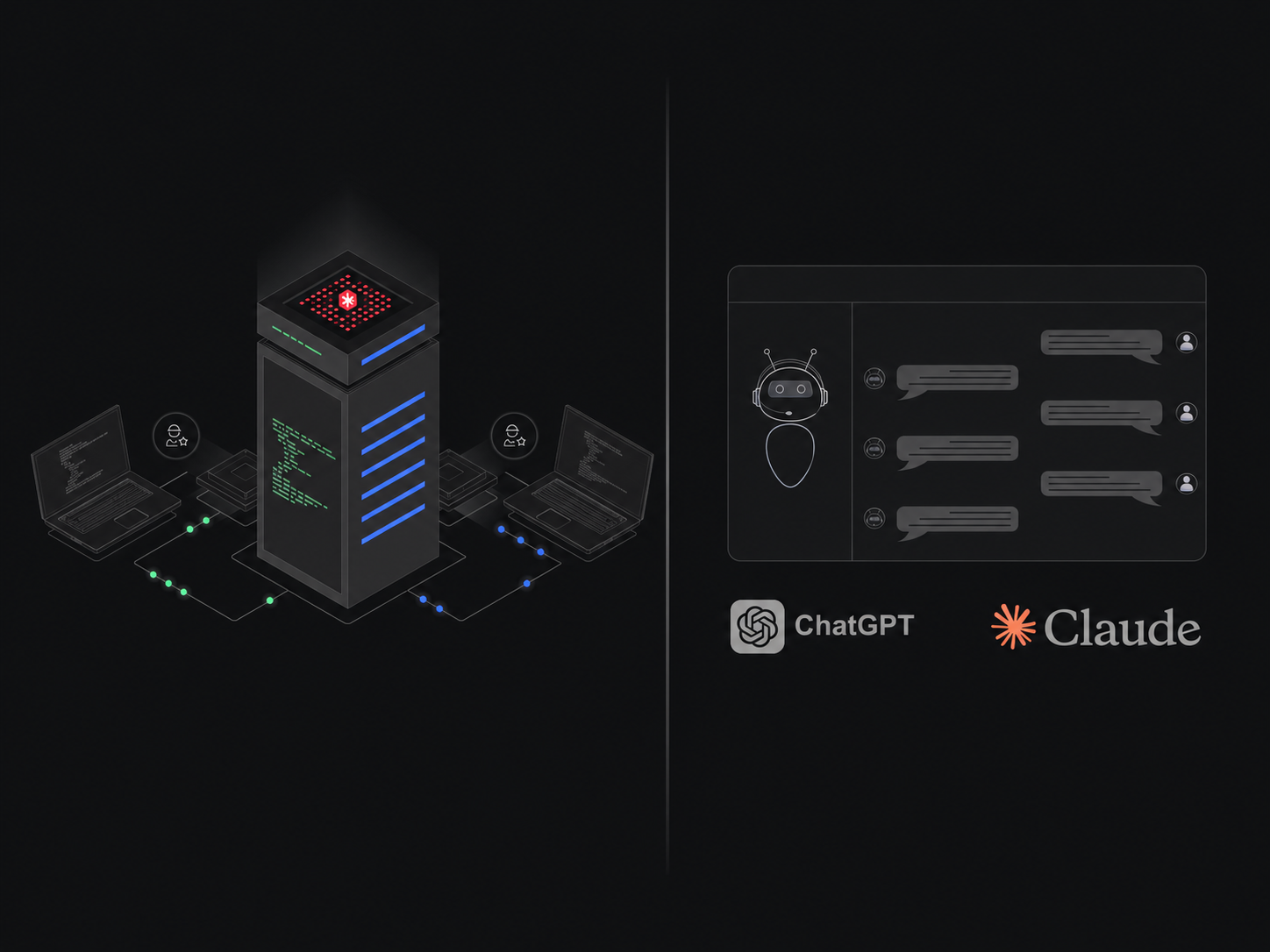
didlogic runs an MCP server at mcp.didlogic.com. Connect it to Claude, ChatGPT, Cursor or any MCP client and your assistant can search number inventory by country, region and city, buy and release numbers, create and update SIP accounts, manage IP allowlists, set inbound routing destinations and priorities, and pull call history and transaction logs.
In practice that means “find me a German landline number, buy it, create a SIP account for it and route it there” is one instruction instead of six screens.
One caution, and we would rather say it than not: language models misread instructions. Number purchases, routing changes and billing actions are real and immediate. Keep a human in the loop on anything that spends money or moves live traffic.
What you get

Local, mobile, national and toll-free numbers, with licensed local voice in 17 countries. From $2.00 a month with inbound from $0.01 a minute.

AS13006, 12 points of presence, around 240 direct carrier agreements, running since 2006. On calls that stay on a regional path, 80% add under 20 ms of network latency.

The same SIP account carries calls into your agent and calls it places. Caller ID passthrough is available from the Plus account level.

TLS signalling on port 5061, using the ISRG Root X1 certificate. SRTP for media on request.

Upload identity and address documents a single time and reuse them across every number purchase that needs them. Automated review returns a decision in 5 to 10 minutes.

Paperless porting in eight countries and porting in 60+ more, scheduled to avoid downtime. Available on Business and Wholesale level accounts.
Who runs BYOC on didlogic
High-volume outbound lives or dies on per-minute cost and on whether the call gets answered. Local caller IDs and CLI rotation matter more than anything happening above the transport layer.
Inbound agents need clean audio, predictable routing and a number that reads as local in the market it serves. One SIP account carries every number you hold.
Teams launching in the Gulf, parts of APAC, Africa and Eastern Europe come to us because the numbers exist here. Licensed local voice in 17 countries, and numbers sourced in markets where most carriers decline.
Asterisk, FreeSWITCH, Vicidial and 3CX deployments run on the same trunks as the AI agents, which is usually the point: one carrier under both the human and the automated side.
FAQ: bring your own carrier for voice AI
What is BYOC in voice AI?
Bring Your Own Carrier is a setup where the AI voice platform and the phone network underneath come from two different vendors. Instead of using the telephony bundled into Vapi, Retell, ElevenLabs or LiveKit, you connect the platform to your own SIP trunk and your own numbers. The usual reasons are per-minute cost, owning the numbers, and reaching countries the bundled inventory does not cover.
What is the difference between BYOC and SIP trunking?
SIP trunking is the technology: a SIP connection between two systems that carries calls. BYOC is a deployment choice that uses it. When you bring your own carrier to a voice AI platform, what you are configuring is a SIP trunk between that platform and your carrier. didlogic provides the SIP trunk, which is what makes the BYOC setup work.
What is Twilio BYOC?
Twilio’s Bring Your Own Carrier feature lets you send voice calls from a Twilio number out over a third-party carrier instead of Twilio’s own voice network, using a termination SIP URI. Teams typically keep Twilio for messaging or for numbers they cannot move yet, and shift the voice minutes elsewhere. If you are weighing a fuller move, the Twilio alternative page covers the comparison properly.
Does BYOC actually save money?
On production volume, usually. The saving comes from the per-minute rate, because bundled telephony is resold with a margin on top. Be clear about what does not change: your platform still charges its own per-minute or per-session fee, and BYOC does not touch that. The break-even sits somewhere between test traffic and first real production load, and it moves depending on which countries you call.
Do you charge per concurrent channel?
Not as a line item on outbound. Concurrency is gated by account level instead: 5 channels on Core, 50 on Plus, and no limit on Premium and above. Raising the limit past the standard threshold requires 2FA and IP restrictions on your SIP accounts, and CPS increases are available on Premium and above once those are in place. Inbound channel increases on a specific number are quoted case by case, because they depend on the country and number type.
How is BYOC on didlogic priced?
Numbers are a monthly rental plus a per-minute rate on the calls they receive, starting from $2.00 a month with inbound from $0.01 a minute. Outbound minutes are billed separately at voice rates by destination. Account levels carry a monthly commitment, which is a minimum spend rather than an extra fee: if usage does not reach it, the difference is charged. See phone number pricing, call rates and account levels.
Are calls billed per second or per minute?
Promo and Core accounts are billed per minute on outbound. Higher account levels get per-second billing. Certain countries apply fixed increments at any level because their telecom regulations require it. For agent calls, which are often well under two minutes, this is worth checking before you model your costs.
Which AI voice platforms work with didlogic?
Vapi, Retell, ElevenLabs Conversational AI and LiveKit have step-by-step guides in our documentation. Beyond those, anything that speaks standard SIP will connect: UDP, TCP or TLS signalling, G.711 or G.729 codecs, SIP REFER for transfers, and either username and password or IP authentication.
Do I need to be a telecom engineer to set this up?
No, but you should be comfortable following a technical guide. It is two configuration steps: create a SIP account on didlogic, then point your platform at it. Per-platform guides cover the specifics, and a voice engineer can join your first deployment on request.
Can I use IP authentication instead of a username and password?
Yes. Contact support and we will create a dedicated SIP account with IP authentication. Some platforms run their SIP signalling from shared addresses, in which case password authentication is the simpler and safer default, so check what your platform recommends before switching.
Which codecs and DTMF methods do you support?
G.711 u-law (PCMU), G.711 a-law (PCMA), G.729 and GSM. You can force a specific codec on your side and our SBC will comply where possible. G.722 wideband is supported, but availability is limited and many carriers do not preserve wideband end to end, so design for G.711 quality. DTMF works in-band and as RFC 2833 / RFC 4733 RTP events.
What do I need to allowlist in my firewall?
Allow RTP audio on ports 10000 to 20000 from any IP. Our media addresses are numerous and change, so allowlisting them individually will break. For signalling, allow our gateways by DNS name rather than by static IP. If your security policy will not permit inbound RTP from any address, email [email protected] and we will provide a specific list to allowlist.
Can my agent transfer a live call to a human?
Yes, through SIP REFER, but it is disabled by default and has to be enabled on your account, so ask before you build against it. Once on, inbound calls can only be referred to another number purchased on your own didlogic account. Outbound transfers go to PSTN numbers. A failed transfer drops the call rather than returning it to the original party, so build a fallback path.
I only see a handful of countries in the portal. Is that your whole catalog?
No. Visible inventory is filtered to what your account is cleared to buy directly, and some countries are restricted until verification is complete. Numbers outside that view are still available through the provisioning team, including bulk orders and number types that are not sold self-service. If the country you need is not showing, ask rather than assuming we do not have it.
Can I port my existing numbers to didlogic?
Yes. Paperless porting in eight countries and porting in 60+ more, scheduled so the number stays live throughout. Porting is available on Business and Wholesale level accounts. Porting numbers to didlogic while keeping your existing vendor for SMS or other rails is a common pattern, and no AI platform’s BYO setup cares which carrier owns the number.
What latency does the carrier layer add?
On calls that stay on a regional path, 80% add under 20 ms. End-to-end conversational latency is dominated by your STT, LLM and TTS providers, which sit well above the transport layer. Choosing the gateway closest to your traffic is the part of the budget you control at the carrier layer.
Can I test before committing?
Yes. New accounts include free test credit and no card is needed to sign up. Two things to keep in mind: your account level carries a monthly commitment once it is active, and some individual numbers carry a minimum service term that is shown before purchase. Neither blocks testing, but both are worth reading before you buy numbers in a dozen countries.
No credit card required. Free test credit included.