
SIP trunk for Asterisk and FreePBX
A SIP trunk built around how Asterisk actually runs
Asterisk has powered serious voice deployments for two decades. The carrier underneath should match. didlogic provides SIP trunks on our own autonomous system (AS13006, the routing network we operate ourselves), with 12 physical PoPs and direct Tier 1 peering with PCCW, GTT, Telia and NTT. We do not sit on top of a third-party cloud voice product. We do not resell another carrier’s trunk.
That matters when your dialplan starts routing real traffic. Asterisk gives you control over every leg of the call. The trunk underneath should not be the part that drops it.
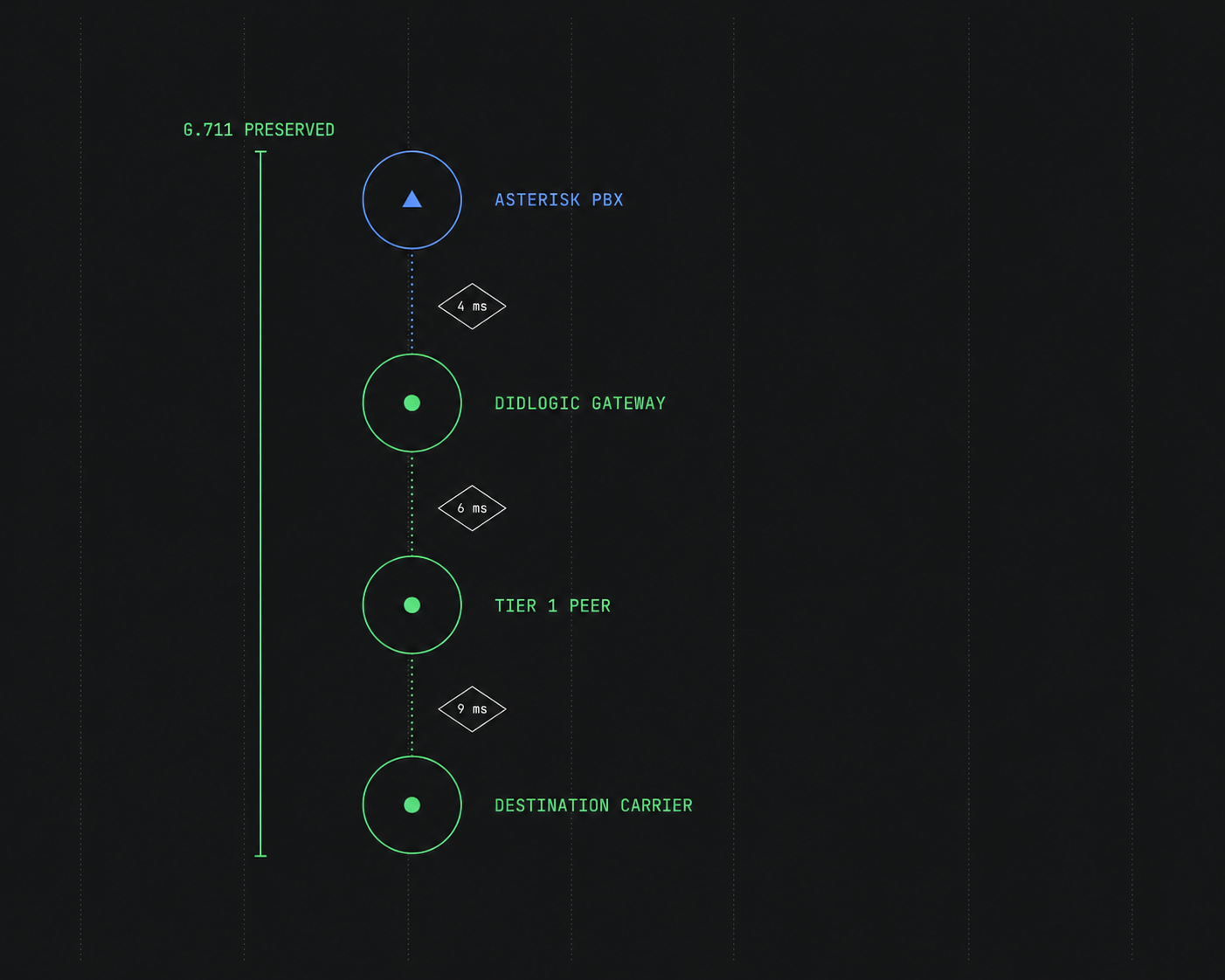
If you are shortlisting a SIP trunk provider for Asterisk, the practical questions are: where are the gateways, are channels metered, and how clean is the codec path. didlogic runs 12 regional SIP gateways across Western Europe, the UK, the Nordics, Africa, the Americas, APAC and Australia. Point your Asterisk trunk at the closest one. Lower PDD, fewer hops, less latency to debug. Channels are not metered. The codec path is G.711 end to end on the didlogic side.
Connect Asterisk to didlogic in three steps
Buy a local or toll-free number in any of 130+ countries from the didlogic portal. Provisioned in seconds.
Create SIP credentials in the didlogic portal. Edit sip.conf (chan_sip) or pjsip.conf (chan_pjsip) with your nearest regional gateway. Digest authentication or IP authentication, your choice.
Forward your didlogic number to your Asterisk endpoint by trunk registration or SIP URI. Place a test call. Most teams go live the same day.
What Asterisk teams get with didlogic

Sub-20ms added media latency on 80% of calls on the carrier-side leg, measured across our 12 PoPs. Direct Tier 1 peering with PCCW, GTT, Telia and NTT keeps the audio path short.

sip.nl, sip.uk, sip.se, sip.de, sip.za, sip.ca, sip.lax, sip.nyc, sip.hk, sip.sg, sip.au, sip.br. Point your Asterisk trunk at the closest one.

Both modules are documented and supported. chan_sip is still operable on Asterisk 20 LTS and earlier. chan_pjsip is the modern path on Asterisk 22 and the only option for new deployments.

Pay per DID and per minute. No charges per concurrent channel, no seat licenses, no CPS gating on production accounts. Concurrency scales without a separate billing conversation.

Send your own CLI on outbound calls from Plus accounts and above, with proof of address on file. Default behavior sends the DID as the outbound CLI.

Port existing numbers into didlogic with paperless LNP in 8 countries and manual porting in most others. Cutover with zero downtime.
| Asterisk requirement | didlogic support |
|---|---|
| chan_sip module | Supported (sip.conf) |
| chan_pjsip module | Supported (pjsip.conf) |
| Digest authentication (username/password) | Supported |
| IP authentication (no registration) | Supported on request |
| UDP signaling on port 5060 | Supported |
| TLS signaling on port 5061 | Supported |
| SRTP media encryption | Supported on request |
| G.711 (ulaw / alaw) codec | Supported |
| G.722 wideband codec | Supported |
| G.729 codec | Supported |
| E.164 dialing format | Required |
| SIP REFER for call transfer | Supported |
| Custom RTP port range | Configurable (10000-20000 in the docs example) |
| FreePBX, Elastix, AsteriskNOW | Compatible |
| Number porting to didlogic | Paperless LNP in 8 countries |
The numbers that matter for Asterisk deployments
Added carrier-side media latency on 80% of calls
Concurrent channels per DID. No per-channel pricing.
Median DID provisioning time from portal checkout to SIP-ready
Regional SIP gateways across Europe, the Americas, APAC and Africa
What Asterisk teams build on didlogic
Terminate client traffic on a trunk you can defend. Wholesale rate ladder, fail over to a second regional gateway by adjusting your Asterisk trunk config, white-label DIDs available. Resellers get a partner-friendly setup without a multi-year contract.
High ASR to fixed and mobile worldwide on A-Z VoIP termination. SIP REFER for warm transfers. Custom CLI rotation on verified Plus accounts. No per-channel concurrency charges as the dialer scales.
Buy a London 020, a Paris 01, or a Sydney 02 number. Point it to your single Asterisk endpoint. Proper local CLI presentation and direct routing into domestic mobile networks. See the UK SIP trunk page for UK-specific deployments.
Asterisk or FreePBX can sit as a SIP gateway between the PSTN and AI voice platforms (Vapi, Retell, LiveKit, ElevenLabs). didlogic handles the carrier side. Asterisk handles the routing and protocol normalization. The AI platform handles the conversation. The three layers stay clean.
| didlogic | Typical SIP trunk | |
|---|---|---|
| Per-channel fees | None | Per-channel pricing |
| Codec end-to-end | G.711 preserved | Often transcoded to G.729 |
| Regional PoPs | 12 worldwide | One or two |
| Network ownership | Own AS13006, own hardware | Resold over underlying carrier |
| chan_sip and chan_pjsip | Both documented | Often only chan_pjsip |
| IP authentication | Supported | Often locked to registration |
| Custom Caller ID | Passthrough on verified accounts | Often blocked |
| Onboarding | Free credits, no commitment 30 days | Sales-gated, multi-year contracts |
| Paperless porting | 8 countries | Varies |
Our clients






































FAQ: SIP trunk for Asterisk
Does didlogic work with Asterisk?
Yes. didlogic SIP trunks work with Asterisk on both chan_sip and chan_pjsip modules. The setup guide on docs covers digest authentication, IP authentication, and FreePBX, Elastix, and AsteriskNOW distributions. A test call typically completes within 10 minutes of finishing setup.
Which Asterisk modules are supported, chan_sip or chan_pjsip?
Both. The didlogic docs include sip.conf examples for chan_sip and pjsip.conf examples for chan_pjsip. Asterisk 22 removed chan_sip from the official source tree, so all new deployments on Asterisk 22 must use chan_pjsip. Existing deployments on Asterisk 20 LTS or earlier can keep chan_sip running through that LTS lifecycle.
Can I use didlogic with FreePBX, Elastix, or AsteriskNOW?
Yes. FreePBX, Elastix and AsteriskNOW all run on Asterisk underneath, so any didlogic trunk that works with Asterisk works with these distributions. Trunk creation is done from the distribution’s admin UI, using either PEER details for chan_sip or pjsip settings for chan_pjsip.
What about Asterisk vs FreePBX, do I need both?
FreePBX is a web administration layer that runs on top of Asterisk. If you want a GUI for managing trunks, extensions, IVR and routing, use FreePBX. If you are comfortable editing sip.conf or pjsip.conf directly, plain Asterisk works without FreePBX. didlogic SIP trunks integrate the same way either route.
Do you support IP authentication or only registration?
Both. Digest authentication (username and password registration) works out of the box from any didlogic SIP account. For IP authentication, email support with your Asterisk server’s static IP and we will enable it on your account. IP authentication is the standard choice for high-volume deployments where registration overhead is not desirable.
What is the SIP gateway hostname for Asterisk?
Use the regional gateway closest to your Asterisk server. Examples: sip.nl.didlogic.net for Western Europe, sip.uk.didlogic.net for the UK, sip.lax.didlogic.net for the US West Coast, sip.nyc.didlogic.net for the US East Coast, sip.sg.didlogic.net for APAC. The full list of 12 gateways is available in the portal and in the setup docs.
Do you charge per channel?
No. You pay per DID and per minute. There is no per-channel concurrency charge on production accounts, which matters when an Asterisk dialer or contact center spikes traffic.
Is there a free SIP trunk for Asterisk?
Not in any production sense. Free Asterisk SIP trunks exist for testing, but they are rate-limited, shared, and not suitable for real traffic. didlogic offers free credits on signup so you can place real test calls on a real trunk before paying for minutes, which is closer to what most “free trunk” searches are actually looking for.
Why are my outbound Asterisk calls returning 603 Declined?
A 603 on outbound is almost always missing or expired SIP registration. Run asterisk -x "sip show registry" (chan_sip) or asterisk -x "pjsip show registrations" (chan_pjsip). The hostname should show as Registered. If not, your credentials, port, or hostname need a closer look. The docs page has the full troubleshooting checklist.
Why am I getting one-way audio on incoming Asterisk calls?
One-way audio is almost always RTP traffic being blocked at the firewall. Open UDP ports in your RTP range (10000-20000 is the didlogic default in rtp.conf) on your edge firewall, and set nat=force_rport,comedia in sip.conf if your Asterisk box is behind NAT.
How do I dial international numbers from didlogic?
E.164 format only. Dial 442035198131 for the UK, not 0044 or 011 or 00. Dial 12125551212 for the US, not 2125551212. Your Asterisk dialplan should normalize whatever the user dials to E.164 before sending the call to the didlogic trunk.
Does didlogic support custom Caller ID on Asterisk outbound calls?
Yes, on verified business accounts at Plus level and above. We require proof of address before enabling Caller ID passthrough. The default behavior on lower account tiers is that the didlogic DID acts as the outbound CLI.
Can I port my existing numbers to didlogic for use with Asterisk?
Yes. didlogic supports paperless LNP in 8 countries and manual porting in most others. Porting does not require Asterisk downtime. A common pattern is keeping the existing trunk live while the port completes, then switching the Asterisk dialplan to the didlogic trunk on cutover day.
How does didlogic compare to Twilio Elastic SIP Trunking for Asterisk?
Two main differences. First, no per-channel fees, which is the line item that bloats Twilio bills on outbound Asterisk dialer deployments. Second, deeper international DID coverage (130+ countries, licensed local voice in 17) versus Twilio’s smaller direct-coverage footprint. The Asterisk configuration is similar on both sides. What changes is the per-month cost at concurrency. See our Twilio alternative for AI voice page for the breakdown.
Can I use Asterisk as an SBC for AI voice agents on didlogic?
Yes. Asterisk or FreePBX can sit as a SIP gateway between the PSTN and AI voice platforms (Vapi, Retell, LiveKit, ElevenLabs). The didlogic trunk handles the carrier side, Asterisk handles routing and protocol normalization, the AI platform handles the conversation. See the AI Voice Hub for platform-specific guides.
Free credits on signup. No payment required. No commitment for 30 days.