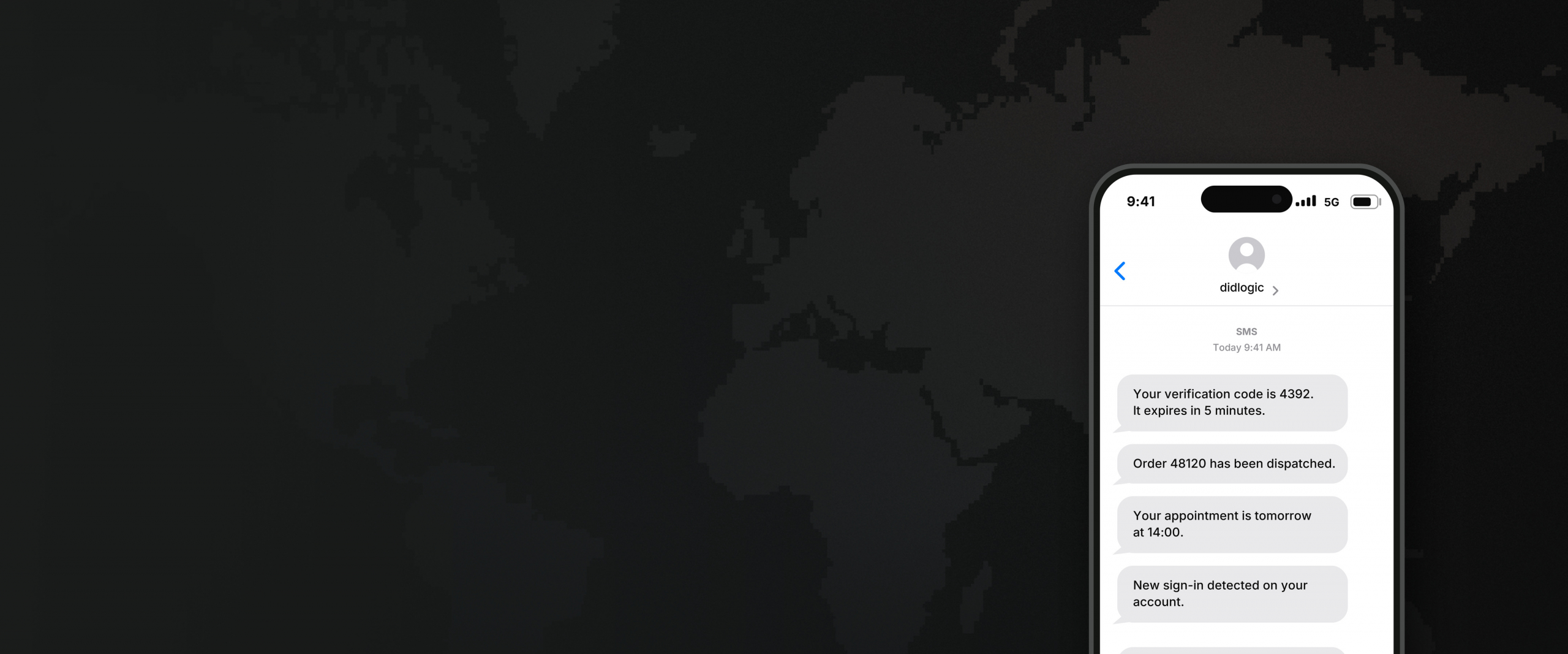








A2P SMS provider for global outbound messaging

Send transactional, OTP and supported promotional SMS worldwide through didlogic. Use your own sender ID, with no phone number to buy, on a route confirmed for your destination, traffic type and message content.
Trusted by

Outbound SMS, built for volume

No phone number required
A DID is not required for standalone outbound A2P SMS. Send messages under your configured sender ID without buying, provisioning or maintaining a phone number.
Your brand as the sender
Send under an alphanumeric sender ID so your company or service name appears instead of a number where the destination supports it. Sender IDs are configured on request and should clearly relate to your business or service.
A–Z A2P coverage
A–Z A2P coverage
Send application-to-person SMS to mobile destinations worldwide. Traffic rules, sender requirements and supported use cases differ by country, so we confirm your destination list against the traffic you actually plan to send.
SMS API and client portal
Integrate outbound SMS into your application through didlogic messaging connectivity or manage sending from your account. The exact setup depends on your account configuration and use case.
Traffic checked before launch
Sender behaviour, traffic type and content restrictions can vary by destination. We review the scenario before traffic starts so you know what is supported for the countries you need.
Voice and SMS with didlogic
Use A2P messaging alongside your existing didlogic voice services, without introducing another telecom provider into your communications stack.

How A2P sending works

Share your destinations, traffic type and sender requirements. We confirm what’s supported, configure the right sender and route, and prepare your traffic for sending.
  1. Step 1

    Share your use case

    Send us your destinations, traffic type, sample content, expected volume and preferred sender ID.

  2. Step 2

    Configure sender and route

    We confirm sender requirements, any required registration, and the appropriate route for your traffic.

  3. Step 3

    Start sending

    Once the setup is complete, you can start sending through the agreed didlogic messaging setup.

What we check before your traffic goes live

A route that works for one type of SMS does not automatically work for every other one. We check the actual combination of destination, traffic type, sender and content before traffic starts.
The route is confirmed for your traffic, not in general
A destination may accept OTP or transactional traffic but restrict promotional messaging. We check your specific use case rather than describing a country simply as “supported”.
Sender behaviour by destination
Sender IDs can behave differently across networks and countries. In some markets an alphanumeric sender is preserved, while in others it can be replaced or overwritten according to local requirements.
Message content can be destination-specific
Certain destinations can apply restrictions or modifications to message content. Representative message text, including links where relevant, should therefore be part of the route review.
Traffic types are treated differently
Transactional, OTP, customer-service and promotional messaging can have different routing and compliance requirements. We match the available setup to the traffic you intend to send.
What kind of traffic can you send?
Availability is destination-specific. A country that supports one traffic category does not necessarily support all of them.
Traffic type Examples What to expect
Transactional SMS Order updates, delivery notices, appointment reminders, account alerts Supported across relevant destinations, subject to destination-specific requirements
Verification and OTP SMS One-time codes, login confirmation, account recovery Supported across relevant routes and destinations, subject to local restrictions
Customer-service messages Service updates, user notifications, account communication Availability depends on destination and message content
Promotional and marketing SMS Offers, product announcements, campaign sends Supported where the destination and available route permit promotional traffic

Sender IDs for A2P SMS

Choose how your business appears to recipients. Sender ID availability and registration requirements vary by destination, so we confirm the appropriate setup for the countries you want to reach.
Alphanumeric sender IDs
Display your company, brand or service name instead of a phone number where supported. Alphanumeric sender IDs are typically 3–11 characters and can contain letters and numbers.
Sender ID registration
Some destinations require sender IDs to be formally registered before use, while others do not. We confirm the requirements for your selected countries and support the required setup.
Numeric senders
Numeric senders
Standalone A2P messaging typically uses an alphanumeric sender ID. If you need SMS tied to a phone number, didlogic also supports SMS-enabled DIDs as a separate setup.

SMS pricing and message segments

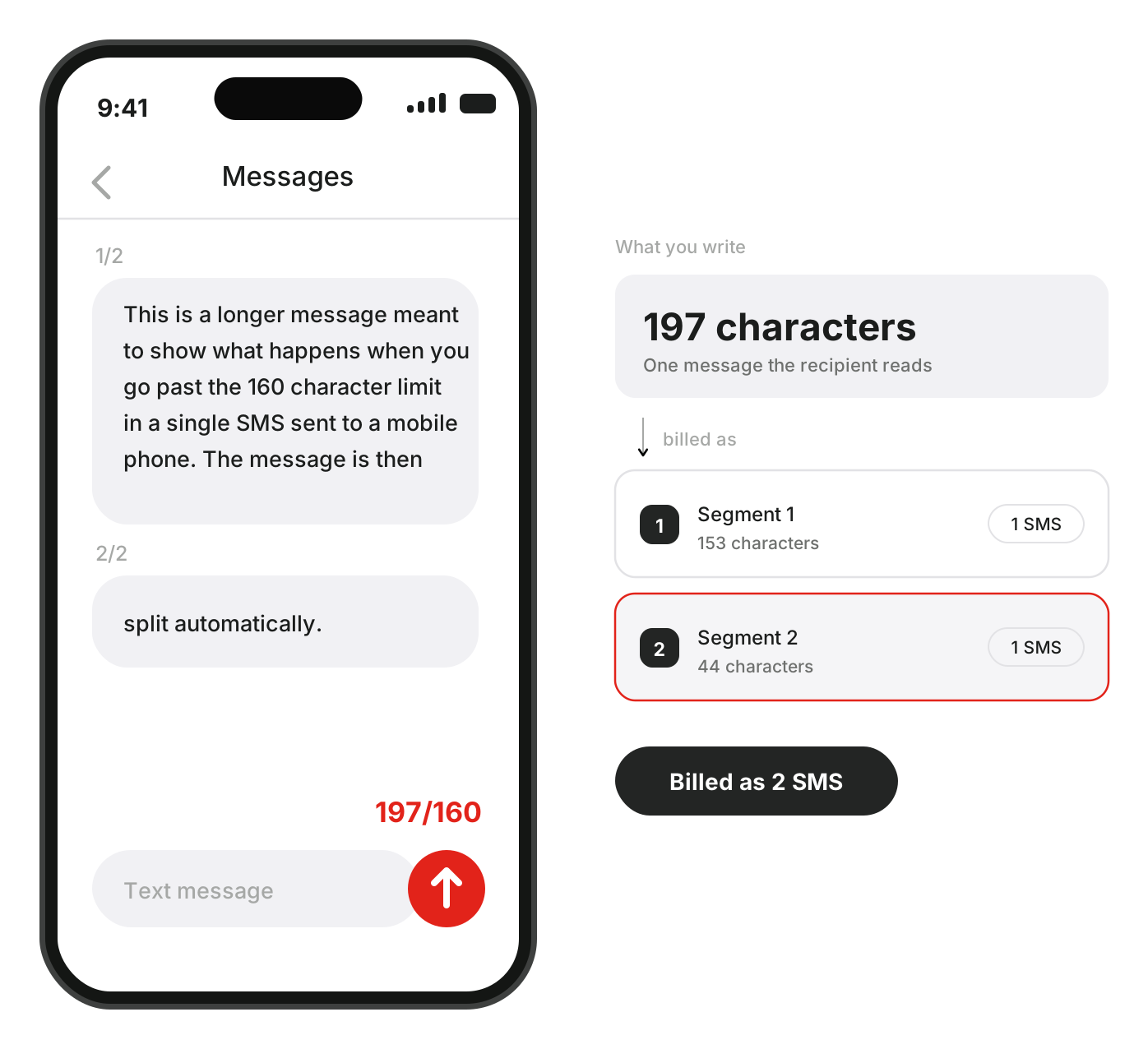
Outbound SMS is priced by destination, but one message does not always equal one billable SMS. Longer messages can be split into multiple SMS segments, with each segment billed separately.

The number of characters per segment depends on the message encoding:

  • GSM-7: up to 160 characters for a single SMS, or 153 characters per segment for longer messages
  • Unicode: up to 70 characters for a single SMS, or 67 characters per segment for longer messages

Unicode encoding can apply to messages containing Cyrillic, Arabic, Chinese, Japanese or Korean characters, emoji and certain special characters.

A message that appears as one continuous text to the recipient may therefore consist of two, three or more billable SMS segments. For high-volume sending, check the final message length, encoding and segment count when estimating costs.

Who sends A2P SMS with didlogic

Communication platforms
Add outbound SMS API connectivity to an existing communications product or workflow.
Contact centers and BPOs
Add transactional or follow-up messaging alongside existing calling operations.
Verification-heavy products
Send OTP, login verification and account-recovery messaging to supported destinations.
Marketing and messaging agencies
Run supported promotional and bulk SMS campaigns across multiple destinations, with requirements checked by market.
E-commerce and logistics
Send order confirmations, dispatch updates, delivery notifications and customer alerts at scale.
Telecom operators and resellers
Add international A2P messaging capacity alongside an existing voice or numbering portfolio.

Why send SMS through didlogic

Traffic reviewed before launch
Your destination, traffic type, sender and representative content are reviewed before the route is confirmed.
Destination-specific routing
A2P SMS behaviour differs significantly across networks and countries. Routes are matched to the use case rather than treated as interchangeable.
Telecom infrastructure since 2006
didlogic has operated international telecom infrastructure since 2006 on AS13006, with 12 points of presence supporting both voice and A2P messaging
Voice and messaging from one provider
Use didlogic for international voice and A2P SMS rather than building separate telecom relationships for each communications channel.

FAQ: A2P SMS

What is A2P SMS?

A2P (application-to-person) SMS is messaging sent from a business application or system to an individual. Common examples include OTP codes, order updates, account notifications, appointment reminders and promotional messages.

Learn more about A2P messaging →

What is the difference between A2P and P2P SMS?

A2P SMS is sent by an application or business system to an individual.

P2P SMS is person-to-person messaging, normally sent from one phone number to another.

The two can use different routing, sender formats and compliance processes.

Do I need a phone number to send A2P SMS?

No.

A DID is not required for standalone outbound A2P SMS. Messages can be sent using an approved alphanumeric sender ID instead.

If you want messaging tied to a didlogic phone number, that is a separate SMS-enabled DID setup.

What is a sender ID?

The sender ID is the name or number shown in the message sender field.

For standalone A2P SMS, an alphanumeric sender ID can display your company, product or service name instead of a phone number where supported.

Can I use any sender ID?

No.

The sender should clearly relate to your company or service. Misleading or inappropriate sender IDs are not accepted.

Some countries additionally require sender registration before the selected sender can be delivered unchanged.

Does didlogic register sender IDs?

Where a destination requires formal mobile-network registration, didlogic can support the registration process as part of the setup.

Not every destination requires sender registration.

An approved sender ID also has to be assigned to the customer’s didlogic account before it is used for sending.

Which countries can I send A2P SMS to?

didlogic provides A–Z A2P coverage.

What varies is the traffic type, sender format and content that can be supported in each destination.

Send us your countries and use case and we will confirm the applicable setup.

Can I send OTP SMS?

Yes.

OTP and verification SMS are supported use cases, subject to destination-specific routing and restrictions.

Can I send transactional SMS?

Yes.

Transactional messaging such as notifications, account alerts and service updates is supported across relevant destinations.

Can I send promotional or bulk SMS?

Yes, where the destination and route support promotional traffic.

Promotional messaging can have more restrictions than transactional or OTP traffic, so availability must be checked for the countries involved.

Can my sender ID be changed before delivery?

Yes.

In some destinations, local network or regulatory requirements can overwrite the submitted sender ID.

Can message content be modified?

In some destinations, yes.

Local requirements or network behaviour can result in content being modified or supplemented before it reaches the recipient.

How is outbound SMS priced?

Pricing depends on the destination and the number of SMS segments sent.

A long message can consist of multiple segments, and each segment is charged separately.

Why can one SMS be billed as two or three messages?

Because SMS is billed by segments.

Long messages are split into several segments. The encoding used by the message also affects the number of characters available per segment.

Unicode characters, non-Latin scripts, emoji and some special characters can therefore increase the number of segments.

Do you support short codes?

Not across most destinations.

Short codes are generally specialised, high-volume messaging products available only in selected markets.

Can recipients reply to an alphanumeric sender ID?

Alphanumeric sender IDs are primarily used for one-way A2P messaging.

If you require two-way SMS, discuss an SMS-enabled DID setup with didlogic.

How do I start?

Send us:

  • your destination countries;
  • traffic type;
  • sample message content;
  • expected volume;
  • preferred sender ID.

We will confirm the relevant setup for your traffic.

GET STARTED →