

didlogic vs Vonage

didlogic vs Vonage for SIP trunking and voice

Compare Vonage SIP trunking and didlogic as the carrier under your PBX, contact center, or AI voice agent. Check inbound numbers, CPS, and support, then test one workload on a free test number.
TWO DIFFERENT VONAGE PRODUCTS

Know which Vonage product you are comparing

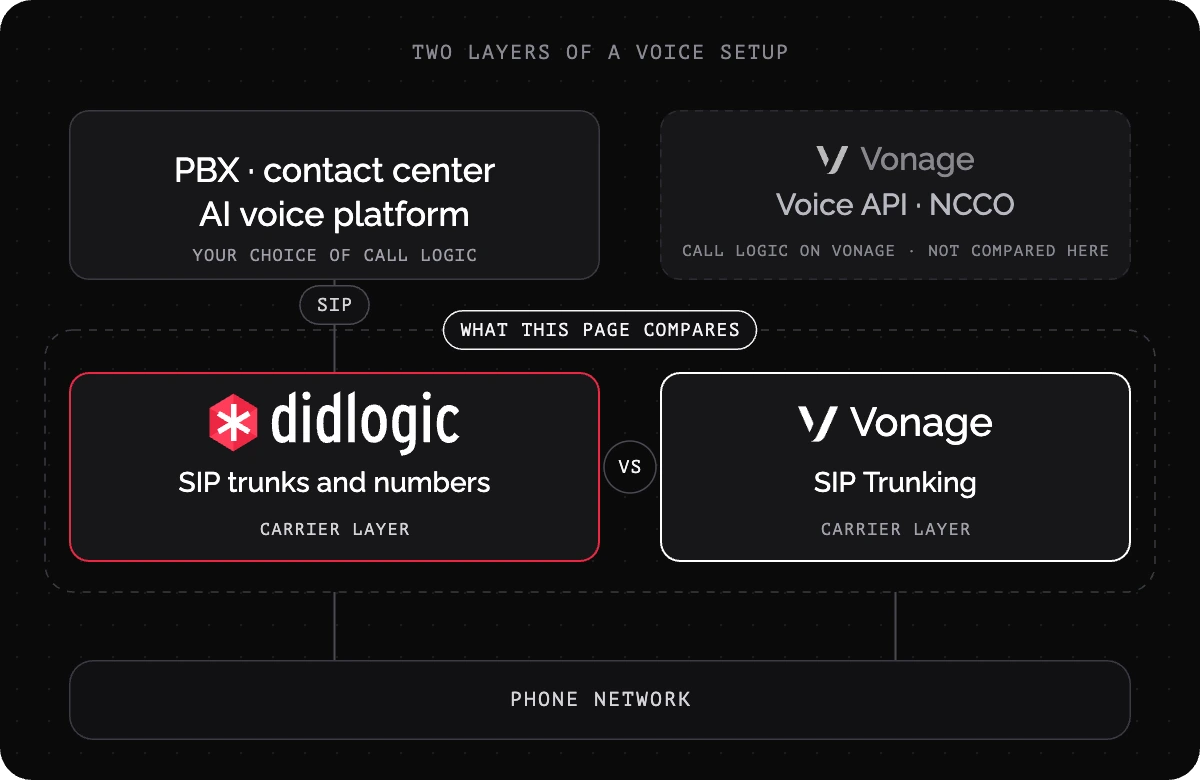
didlogic is a carrier that operates its own network: 12 physical PoPs, its own Autonomous System (AS13006), and SIP trunks and numbers provisioned in the portal or through the API, with no per-trunk or per-channel fee. Its counterpart at Vonage is Vonage SIP Trunking, which connects a PBX, SBC, or contact center to the phone network; Vonage’s Voice API runs call logic with NCCO flows on Vonage itself.

Voice API and NCCO flows are a different layer, so they are not compared here. If you plan to run a PBX, an SBC, or an external AI platform, the carrier layer is the one to compare.

Compare didlogic with Vonage SIP trunking on one route group, with the same calls on both sides.

Two layers of a voice setup: call logic on top, carrier layer below. This page compares didlogic with Vonage at the carrier layer.
START WITH THE WORKLOAD

Which one fits your stack?

Both connect SIP traffic to the phone network. didlogic adds its own network, published per-route rates, and 24/7 engineer support. Choose by where your call logic runs, and by how you want inbound numbers and routes set up.

Where didlogic is the stronger choice
  • You are comparing carrier terms for a PBX or contact center, not building a new Voice API app.
  • Your traffic goes to international destinations and you want rates per route before you sign up.
  • You want inbound numbers rented by country, with availability and monthly fees checked per market.
  • Carrier issues should reach an engineer through a ticket, 24/7, not depend on a paid support tier.
  • You want a carrier that operates its own network, with 12 physical PoPs and AS13006, and no per-trunk or per-channel fee.
Where Vonage is a good fit
  • Your app runs on Vonage’s Voice API or AI Studio.
  • You want voice, messaging, Verify, and video APIs from one provider.
  • Your numbers are already on Vonage and the carrier layer is not what you want to change.

didlogic vs Vonage SIP Trunking

How the two compare on one SIP workload. Vonage details come from Vonage’s public pricing and documentation; check them against your own account. On mobile, swipe the table to compare every column.
Decision area didlogic Vonage SIP Trunking
What you buy SIP trunks, phone numbers, and inbound and outbound voice for the stack you already run. SIP trunking inside a communications API platform that also sells Voice API, messaging, Verify, and video.
Inbound calls An eligible didlogic number routes inbound calls to your SIP endpoint; availability and monthly fees vary by market and number type. An eligible voice-enabled Vonage virtual number routes inbound calls to the trunk; availability and monthly fees vary by market.
Outbound rates Published per route and operator, so you can check rates before you sign up. Pay-per-use from a rate sheet in the Vonage dashboard, billed per second in all countries.
Calls per second Raised on request for the trunk that carries your test. Default of 3 outbound CPS, raised through support; calls over the limit are typically rejected with SIP 503.
Setup SIP trunk and number provisioning in the portal or through the API. Trunk creation, IP allowlisting, and numbers in the Vonage dashboard, with guides for Asterisk, FreePBX, and Genesys Cloud.
Support An engineer answers your ticket, 24/7. Standard support is included in business hours. Optional paid support plans start at $350 a month for 24/5 and $1,650 a month for 24/7.
Call logic Stays in your PBX, contact center, AI platform, or SIP application. Can stay in your system, or run on Vonage’s Voice API.
SUPPORT HOURS

Support hours, side by side

Vonage includes standard support in business hours. Optional paid support plans start at $350 a month for 24/5 and $1,650 a month for 24/7.

On didlogic, an engineer answers your ticket, 24/7. The right fit depends on the support hours, response model, and escalation path your traffic requires.

Weekly support hours: Vonage Standard in business hours, Essentials 24/5, Premium 24/7, compared with an engineer answering didlogic tickets 24/7
WHERE TO START

Good workloads to test first

AI voice agents
AI voice agents
If Vapi, Retell, LiveKit, or your own stack runs the agent, point one market’s SIP trunk at didlogic and compare the same calls.
International outbound
Compare per-route rates, call completion, and caller ID on one destination group.
Numbers by country
Numbers by country
Check number availability for the markets you add, then route inbound calls to your existing PBX or platform.
Bursty dialer traffic
Campaigns that start calls faster than Vonage’s default 3 CPS. Set the test trunk to your real peak.

The didlogic network, in numbers

didlogic operates AS13006 across 12 physical PoPs, with direct Tier 1 connectivity and SIP provisioning through the portal or API. Evaluate routing and call quality using your own traffic.

PoPs

physical points of presence on the didlogic network

AS

didlogic-operated Autonomous System

$

per SIP trunk or channel fee

CALLS PER SECOND

Check capacity before a dialer or AI workload goes live

On didlogic

CPS and concurrent channels are raised on request for the trunk that carries your test. Outbound channels are set by account level: 5, 50, or unlimited.

On Vonage SIP Trunking

Outbound calls start at 3 CPS, counted over a rolling second. Higher limits are requested through support, and calls over the limit are typically rejected with SIP 503.

AI agents and dialers start calls in bursts. Bring your real peak CPS so both sides are tested at the rate you will actually run.
COMPARE THE COST MODEL

What moves the bill on each side

Bring these to get a like-for-like quote
  • Destinations and fixed/mobile mix.
  • Inbound and outbound minutes, plus average call duration.
  • Billing increments: Vonage bills per second in all countries, so compare increments for the same destinations.
  • Numbers you need, and how inbound calls reach your system.
  • Support level you need: Vonage’s 24/5 and 24/7 plans are separate monthly fees.
  • Peak CPS and concurrent calls.
Cost model comparison: Vonage bills outbound calls from a rate sheet per second, needs a voice-enabled Vonage number for inbound calls, and lists optional support plans from $350 a month; didlogic bills minutes per route and country, number rental by country, and raises CPS on request.
TEST BEFORE YOU DECIDE

Test on your own traffic before you commit

Whether you are choosing your first provider or adding a second one, start with one market, route group, or AI agent. Expand only if the result justifies it.
  1. Step 1

    Add a didlogic test connection

    Claim a free test number once your business account is reviewed, add a test trunk, set authentication and caller ID, and agree the destinations to test.

  2. Step 2

    Route a representative sample

    Use one market, one route group, one AI agent, or a controlled share of outbound traffic.

  3. Step 3

    Measure both on the same calls

    Measure call completion, post-dial delay, caller-ID presentation, audio, DTMF or transfers, billing increments, and unit cost on comparable traffic.

  4. Step 4

    Expand only if it earns it

    Add routes, markets, or numbers only after the technical and commercial result is clear. Porting stays a separate decision.

CUSTOMER STORY

Why an Albanian dental clinic calls its European patients on local numbers

Family Dental Care treats patients travelling from Italy, Germany and France, but calls from an Albanian number went unanswered by people who had just filled in an enquiry form. The clinic now runs local numbers in each target market through didlogic, so a prospective patient sees a domestic number and can call straight back on it.

3 markets with local numbers
Italy, Germany, France patient source markets

Read the customer story arrow-black-right

didlogic vs Vonage FAQ

Is didlogic a Vonage alternative for SIP trunking?

Yes. didlogic is a carrier-layer alternative to Vonage SIP Trunking, with its own network, published per-route rates, and 24/7 engineer support. Vonage’s Voice API and NCCO flows are a different layer, so they are compared separately.

Do I need a Vonage number to receive calls on a SIP trunk?

Yes. Both providers require an eligible number for inbound calling. Vonage uses a voice-enabled virtual number; didlogic uses an available number for the selected market. Compare number availability, monthly fees, inbound rates, setup requirements, and whether you need Voice API/NCCO or a standard SIP trunk.

How do CPS limits compare?

Vonage starts at 3 outbound CPS and raises it through support; calls over the limit are typically rejected with SIP 503. On didlogic, CPS and channels are raised on request. Test both at your real peak.

How does support compare?

Vonage includes Standard support in business hours and offers optional paid 24/5 and 24/7 plans starting at $350 and $1,650 a month. On didlogic, an engineer answers your ticket 24/7. Check Vonage’s current plan terms for your account.

Does didlogic offer US phone numbers?

didlogic does not currently offer US numbers. It specialises in international numbers and routes, so you can add it for the markets outside the US.

Which setup makes sense for an AI voice agent?

didlogic is built for agents that run on Vapi, Retell, LiveKit, ElevenLabs, or your own stack: it carries the SIP calls, with CLI passthrough and capacity raised on request. Compare the carrier on the same calls. Vonage’s own AI tooling is a separate layer.

Is there a free test?

Yes. Business accounts get a free test number after a short review. Ask sales about testing credit for outbound routes.

Can I port numbers from Vonage to didlogic?

Eligible numbers can be ported in selected countries, with documents and timing set by the country and number type. Confirm the exact numbers with the porting team and keep the current service active until the port completes.

Related didlogic services

SIP trunking

Connect an existing PBX, SBC, contact center, or voice application to didlogic for inbound and outbound calling.

Outbound voice

Connect an existing communications system to fixed and mobile networks and compare routes for the destinations you actually call.

AI voice

Connect Vapi, Retell, LiveKit, or ElevenLabs to didlogic over SIP.

Talk to sales

Tell us what you need. We’ll help you find the right options for coverage, pricing, and setup.

No account required. We’ll reply by email. Read our Privacy Policy.