
didlogic vs Twilio

didlogic vs Twilio for SIP trunking and voice

Compare didlogic with Twilio Elastic SIP Trunking for your PBX, contact center, or AI voice platform. Review connectivity and route pricing, then test one workload without replacing the rest of your stack.
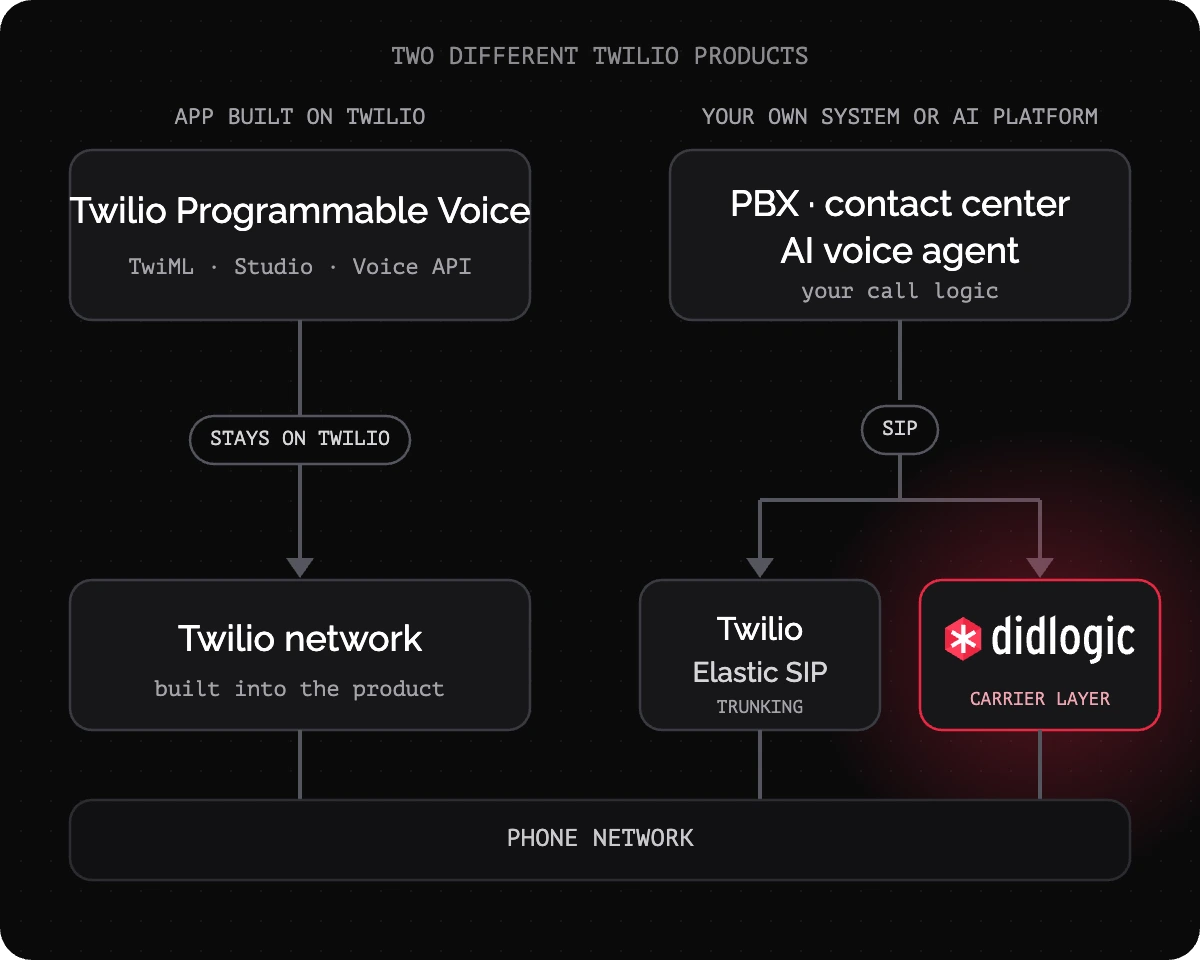
TWO DIFFERENT TWILIO PRODUCTS

Know which Twilio product you are comparing

Twilio Elastic SIP Trunking connects existing PBXs and SIP systems to the phone network. Programmable Voice handles call logic through TwiML, Studio, and the Voice API.

Programmable Voice can use Twilio’s network or an external carrier through BYOC Trunking.

Compare didlogic and Twilio Elastic SIP Trunking using comparable routes and traffic.

Twilio Programmable Voice keeps call logic and connectivity on Twilio; for your own PBX or AI platform, Twilio Elastic SIP Trunking and didlogic are both carrier options over SIP.
START WITH THE WORKLOAD

Which one fits your stack?

Start with where your call logic runs. If your PBX, contact center, or AI platform already handles it, compare SIP connectivity, routing, CPS, and pricing.

Consider didlogic for the carrier layer when
  • Your PBX, SBC, contact center, or AI platform already handles call logic, and you need SIP connectivity.
  • You want to compare outbound rates by route and operator.
  • You need to evaluate CPS and concurrent-call capacity for growing or variable traffic.
  • You want to test a defined workload before moving more traffic.
  • You want an engineer to answer your ticket, 24/7, without paying for a support plan.
Consider Twilio's application layer when
  • Your workflows depend on TwiML, Studio, or the Twilio Voice API.
  • You rely on Twilio for voice, messaging, and other application services.
  • Rebuilding your existing application would introduce unnecessary cost or operational risk.
WHERE THE CARRIER FITS

Keep the application. Compare the voice layer.

See how to test didlogic with your existing PBX, AI voice platform, or Twilio setup.

1. Existing PBX or contact center

Point a didlogic trunk at it and compare routes, CPS, and support against your current Twilio trunk.

2. AI voice platform runs the agent

Keep Vapi, Retell, LiveKit, or ElevenLabs; send one market through didlogic and compare the same calls.

3. App built on Programmable Voice

Keep it on Twilio. Test any separate SIP traffic (a PBX, a dialer) on didlogic on its own.

didlogic vs Twilio Elastic SIP Trunking

Only what changes if you move one SIP workload. Twilio details come from Twilio's public pricing and documentation; check them against your own contract.
Decision area didlogic Twilio Elastic SIP Trunking
Network didlogic-operated: own Autonomous System (AS13006), 12 physical PoPs, IP transit bought directly from Tier 1 carriers. Twilio's cloud platform with regional edge locations.
Calls per second Published rates by route and operator. Published per-minute rates by destination.
Outbound rate structure Published per route and operator, so you can check rates before you sign up. Per-minute termination by country and zone.
Support An engineer answers your ticket, 24/7. No separate support plan to buy. Free plan: no guaranteed response time. Guaranteed response from $250 a month or 4% of monthly spend.
CALLS PER SECOND

Check CPS before an AI or dialer workload goes live

On didlogic

CPS and concurrent-call capacity can be increased on request. Confirm the limits for your workload before testing.

On Twilio Elastic SIP Trunking

1 CPS per trunk per region by default. Higher CPS is available through paid upgrades or account-level pooling.

AI agents and dialers start calls in bursts. Bring your real peak CPS so both sides are tested at the rate you will actually run.

The didlogic network, in numbers

When a route misbehaves, the engineers handling your ticket work on the same network your traffic crosses. These are network facts to check on your own test traffic, not a promise about every call.

PoPs

Physical points of presence on the didlogic network

AS

didlogic-operated Autonomous System

Tier 1 carriers

Direct IP transit from PCCW, GTT, Telia, and NTT

COMPARE THE COST MODEL

What moves the bill on each side

Bring these to get a like-for-like quote
  • Destinations and fixed/mobile mix.
  • Inbound and outbound minutes, plus average call duration.
  • Phone numbers and markets that are actually in use.
  • Peak CPS and concurrent calls. On Twilio, CPS above 1 per trunk per region is a separate monthly charge.
Cost model comparison: Twilio Elastic SIP Trunking bills outbound and inbound minutes, phone numbers, and extra CPS as a monthly add-on; didlogic bills minutes per route and country, number rental by country, and raises CPS on request.
TEST BEFORE YOU MOVE

Test didlogic without touching the rest of your stack

No porting and no redesign. Production numbers and application logic stay where they are while you test.
  1. Step 1

    Add a didlogic test connection

    Claim a free test number once your business account is reviewed, add a test trunk, set authentication and caller ID, and agree the destinations to test. An engineer helps you connect it.

  2. Step 2

    Route a representative sample

    Use one market, one route group, a test number, or a controlled share of outbound traffic.

  3. Step 3

    Measure both on the same calls

    Measure call completion, post-dial delay, caller-ID presentation, two-way audio, DTMF or transfer behaviour, billing increments, unit cost, and support handling on comparable traffic.

  4. Step 4

    Scale only if it’s worth it.

    Increase route share, add numbers, or plan eligible ports only after the technical and commercial result is clear. Porting stays a separate decision.

RUN BOTH WHILE YOU TEST

How parallel SIP routing works

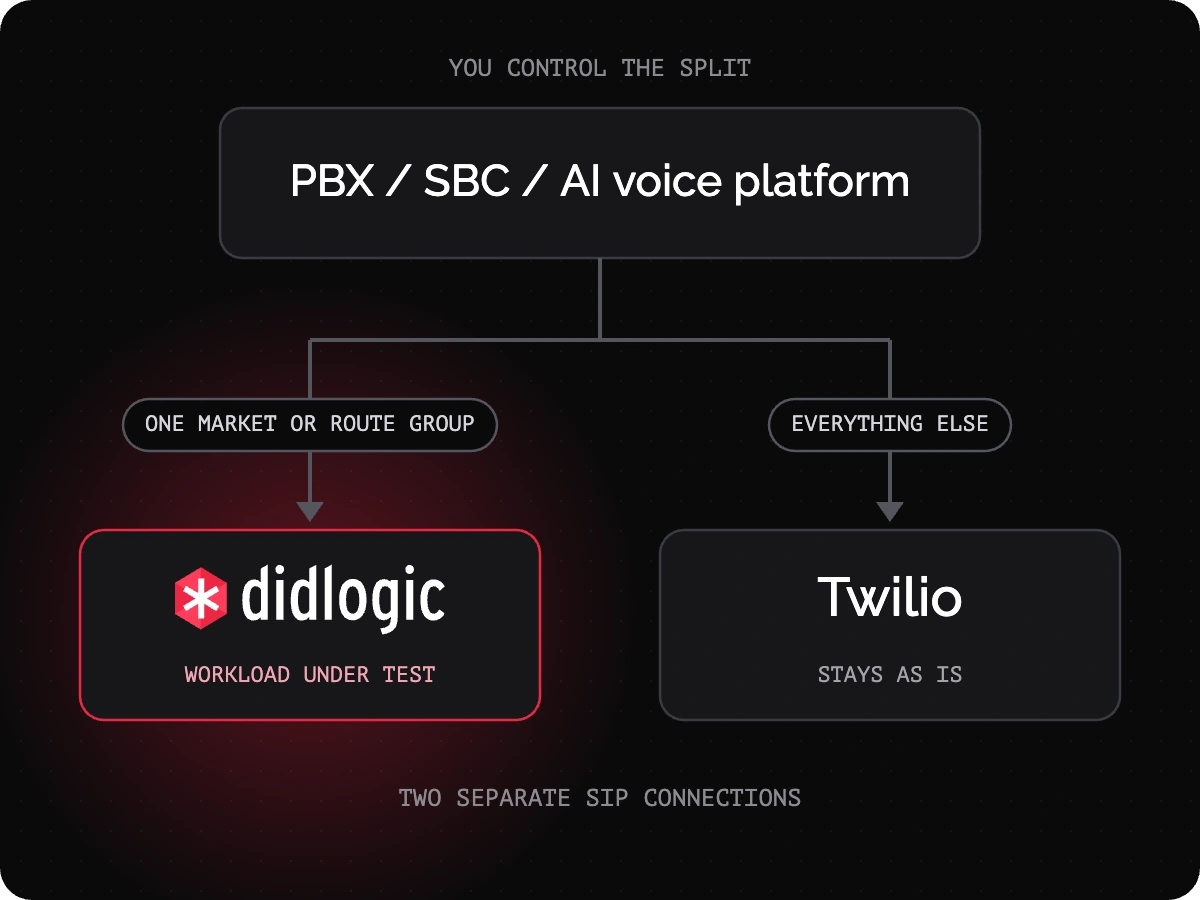
If your PBX, SBC, or AI platform supports multiple SIP connections, it can send selected calls through didlogic while other traffic stays on Twilio.

  • Routing control: Your SIP-capable platform decides which trunk carries each call.
  • Separate connections: didlogic and Twilio receive traffic over separate SIP trunks.
  • Unchanged services: Twilio-native application logic and messaging remain outside this SIP test.

Two providers do not automatically mean redundancy. That depends on how your routing is set up.

Your PBX, SBC, or AI voice platform sends one market or route group to didlogic for testing and keeps everything else on Twilio, over two separate SIP connections

CUSTOMER STORY

Keep your CRM. Add didlogic routing.

A high-volume GoHighLevel customer needed didlogic routing while keeping its Twilio-based CRM. Our engineers delivered a native Twilio integration in five business days, enabling all three systems to work together without changing the CRM workflow.

5 BUSINESS DAYS TO INTEGRATE

Explore AI voice integrations arrow-black-right

didlogic vs Twilio FAQ

Is didlogic a Twilio alternative for SIP voice?

Yes, when the part you want to change is SIP/PSTN connectivity. Compare didlogic against Twilio Elastic SIP Trunking on the same workload. If your product also relies on Twilio-native application logic, keep that dependency in place and evaluate the voice layer separately.

How does support compare?

On didlogic, engineers answer support email 24/7, and urgent issues go straight to a network engineer, with no ticket queue and no scripts. Twilio’s free plan has no guaranteed response time; guaranteed response starts with its Production plan, priced at $250 a month or 4% of monthly spend, whichever is greater.

How do CPS limits compare?

Twilio Elastic SIP Trunking starts at 1 CPS per trunk per region. Raising it (up to 5 per trunk, or pooled across the account) is a paid monthly add-on, and higher limits go through Twilio sales. On didlogic, CPS and concurrent channels are raised on request, usually the same day. Check both against your real peak.

Is there a free test?

Yes. Business accounts get a free test number after a short review. Ask sales about testing credit for outbound routes.

Does Twilio also offer SIP trunking?

Yes. Elastic SIP Trunking is Twilio’s standalone SIP product. That is the relevant Twilio comparison for an existing PBX or SBC; Programmable Voice is a different application-level purchase.

Can I test didlogic before moving production traffic or numbers?

Yes. Start with a test SIP connection, a new number where appropriate, or a limited route group. Validate call behaviour, billing, and support before deciding whether production traffic or numbers should move.

Can I keep existing Twilio services while testing didlogic?

Usually, where your architecture supports multiple providers or separate workloads. Keep services outside the test scope unchanged and isolate the voice workload you want to compare. Validate any BYOC or other interconnection pattern before production use.

How should I compare didlogic and Twilio pricing?

Use the same destination mix, call direction, minutes, average duration, number inventory, and capacity requirements. Include only the application-layer charges that actually remain in your stack. A single per-minute headline can be misleading when the architectures differ.

Which setup makes sense for an AI voice product?

If an external platform already handles orchestration, speech, and agent behaviour, keep that platform fixed and compare the carrier layer separately. If your application logic is Twilio-native, keep that application dependency in place and isolate a voice workload only where a separate carrier test is useful.

Can I port numbers from Twilio to didlogic?

Eligible numbers can be ported, but portability, documents, fees, and timing depend on the country and number type. Check the exact inventory before planning a cutover and keep the current service active until the port is confirmed.

Related didlogic services

SIP trunking

Connect an existing PBX, SBC, contact center, or voice application to didlogic for inbound and outbound calling.

Phone numbers

Check local, mobile, national, and toll-free number options by market and route inbound calls to your existing stack.

Outbound voice

Connect an existing communications system to fixed and mobile networks and compare routes for the destinations you actually call.