
Quick support work
Had a cli issue on one dutch route. Sip side was fine, but the outbound number wasn't behaving as expected. Sent support a few call examples and they helped quickly. The next test calls came through as expected
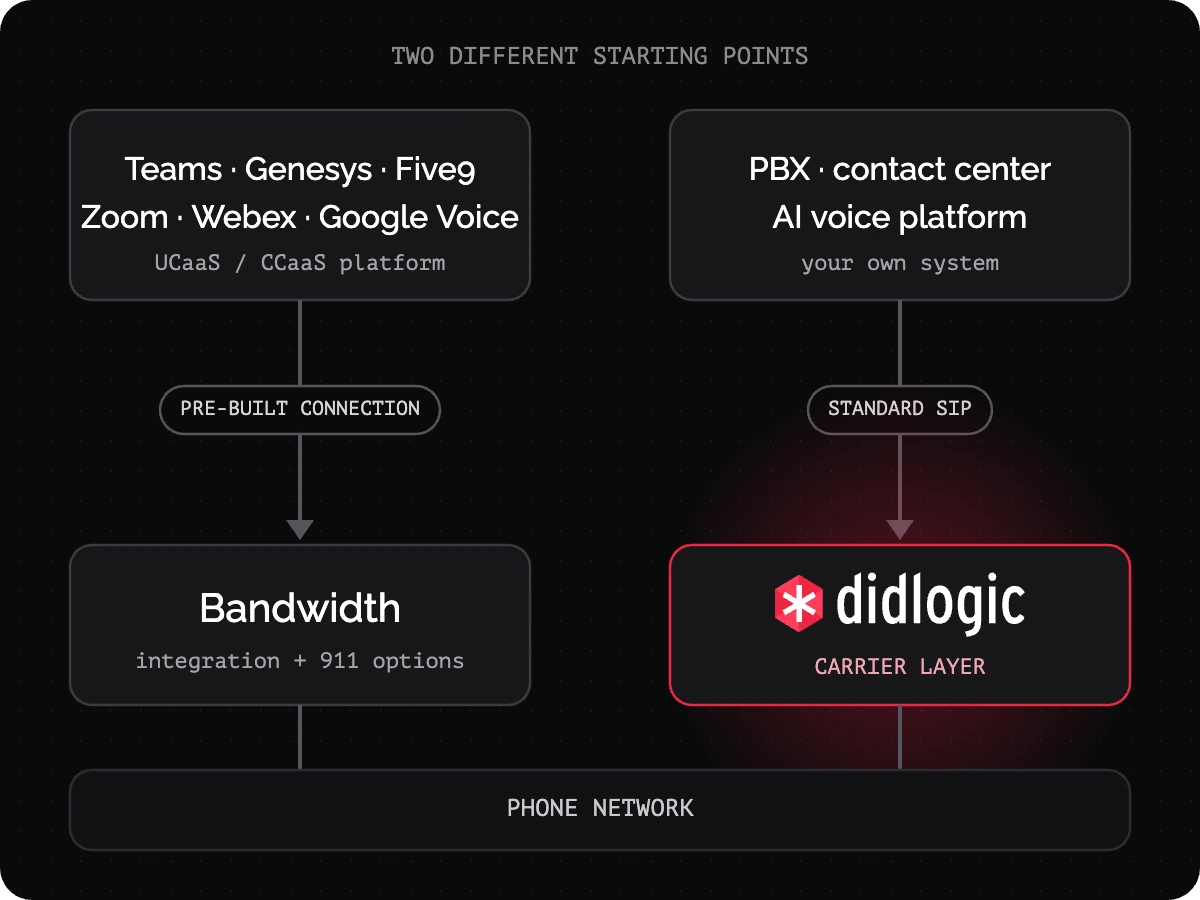
Bandwidth can cover the same SIP layer and also offers a broader enterprise communications platform with pre-built integrations for major UCaaS and CCaaS products. The practical question is how much of that surrounding platform your voice workload actually needs.
Both providers can connect SIP traffic to the PSTN. The difference becomes clearer when you separate a defined carrier workload from a broader communications deployment.
Bandwidth offers pre-built connections for Microsoft Teams (Direct Routing and Operator Connect), Genesys Cloud CX, Five9, Zoom Phone, Webex Calling, and Google Voice. In the US and Canada it also runs its own 911 network, with options such as Dynamic Location Routing for hybrid workforces.
If one of those is a procurement or architecture requirement, start the comparison there.
If your PBX, contact center, or AI platform connects over standard SIP instead, the decision is a carrier decision. Test that layer on its own.
| Decision area | didlogic | Bandwidth |
|---|---|---|
| Primary voice fit | Defined SIP/PSTN workloads underneath an existing PBX, contact center, AI platform, SBC, or other SIP application. | SIP connectivity plus broader enterprise communications deployments, integrations, emergency services, APIs, and number-management tooling. |
| Starting a SIP test | Create a business account and request a 30-day test number. Availability and testing conditions depend on the target market. | Bandwidth Build offers self-service SIP testing with trial credits and US phone numbers. Broader international SIP services are available separately. |
| Platform integrations | Connect through standard SIP to the application or platform you already operate. | Pre-built connections for platforms including Microsoft Teams (Direct Routing and Operator Connect), Genesys Cloud CX, Five9, Zoom Phone, Webex Calling, and Google Voice. |
| Commercial evaluation | Published per-operator outbound rates, pay-as-you-go billing, and no separate trunk or channel fees or monthly minimums on standard accounts. Quote for specific volumes and account requirements. | SIP Trunking uses a customizable usage-based model; full production pricing and custom integration pricing are supplied for the selected configuration. |
PoPs
physical points of presence on the didlogic network
AS
didlogic-operated Autonomous System
$
per SIP trunk or channel fee
A free test number for business accounts after a short review, a SIP trunk to your existing system, and outbound routes for the markets you choose.
Since September 2026, Build lets trial users set up SIP trunking for US numbers through the app, API, or CLI, using free trial credits. Broader global and multi-service deployments run on Bandwidth’s wider platform.
Use one destination group, market, number set, site, or controlled traffic segment.
Keep the PBX, contact center, SBC, AI platform, or application unchanged.
Use comparable call types, destinations, and traffic conditions.
Measure call completion, post-dial delay, caller-ID presentation, audio, DTMF or transfer behaviour, billing, unit cost, and support handling.
Increase route share, add numbers, or plan eligible ports only after the technical and commercial result is clear.
CUSTOMER REVIEWS
Published reviews from teams running traffic through didlogic, on Trustpilot and G2.
It can be a direct alternative when the part you are evaluating is SIP/PSTN connectivity for an existing PBX, contact center, SBC, AI platform, or other SIP application. If your deployment depends on Bandwidth-specific integrations or a broader enterprise communications program, keep those requirements separate from the carrier test.
Yes. Bandwidth Build added SIP Trunking in September 2026 and supports trial setup through the app, API, and CLI. The current Build entry path is for US phone numbers; broader global and multi-service deployments use Bandwidth’s wider production platform.
Bandwidth may be the stronger fit when a pre-built connection with products such as Microsoft Teams, Genesys, Five9, Zoom, Webex, or Google Voice is a core architecture requirement, or when the organization wants a broader enterprise communications program from one provider.
Usually, yes, where the application supports separate SIP trunks, route groups, markets, or number sets. Keep services outside the test scope unchanged and isolate the voice workload you want to compare.
Use the same markets, call direction, minutes, average duration, number inventory, CPS/concurrency, and supporting services. Include integrations or emergency services only when they are actually required by the deployment. A single per-minute rate is not a complete comparison.
Eligible numbers can be ported, but portability, documentation, fees, and timing depend on the country and number type. Check the exact inventory before planning a cutover and keep the existing service active until the port is confirmed.
If a Bandwidth pre-built connection is a formal requirement, that can be a strong reason to use Bandwidth. If the platform accepts standard SIP/BYOC connectivity and the job is a defined PSTN workload, compare didlogic on the exact markets and traffic instead of deciding from the size of the surrounding product catalog.
MORE COMPARISONS
Explore other provider comparisons for SIP, phone numbers, voice infrastructure, and deployment scope.
Connect an existing PBX, SBC, contact center, or voice application to didlogic for inbound and outbound calling.
Connect an existing communications system to fixed and mobile networks and compare routes for the destinations you actually call.
Check local, mobile, national, and toll-free number options by market and route inbound calls to your existing stack.