
Number porting is the regulated process that moves a telephone number from one provider to another while the number itself stays the same. The number keeps its digits, its country code and its area code. What changes is which network is responsible for delivering calls to it, and which company bills the subscriber. Every network that might route a call to that number has to learn the change, which is why porting is as much a database and routing problem as it is a paperwork problem.
Regulators define this narrowly. Under the United States numbering rules, number portability means the ability to retain existing numbers, at the same location, without impairment of quality, reliability or convenience when switching from one carrier to another. The phrase “at the same location” is doing real work: moving a number between providers is one thing, and moving it between geographic areas is a different capability that most numbering plans do not grant.
Quick facts
| Question | Answer |
|---|---|
| What moves | Responsibility for routing and billing the number |
| What does not move | The digits, the number’s national significance, your trunks, PBX or applications |
| Common names | Local number portability (LNP), number portability (NP), porting, migration |
| Parties involved | Gaining (recipient) provider, losing (donor) provider, range holder, portability database |
| Who starts it | The customer, through the gaining provider, in most modern processes |
| Typical rejection causes | Mismatched account data, wrong billing telephone number, pending orders, address mismatch |
| Where the routing lives | A national portability database, or a lookup on the range holder’s network |
| Regulated intervals | One business day for simple ports in the US; loss of service capped at one working day under EU rules |
| Not carried by the port | Emergency service registration, messaging capability, directory listing, contractual terms |
What porting actually transfers, and what it does not
A telephone number is not property. In most numbering regimes the regulator allocates blocks of numbers to communications providers, and providers may only adopt and use numbers that have been allocated to them or that they are authorised to use by the allocation holder. Ofcom’s General Condition B1 states this directly for the United Kingdom. The subscriber holds a right to use a number and a right to take it to another provider, not a title to it.
So a port transfers three things:
- Routing responsibility. After the port, the gaining provider’s network is where calls to that number terminate.
- The billing relationship. The gaining provider becomes the provider of record for that number.
- The record in the portability system. Other networks need this to route correctly.
A port does not transfer your SIP trunks, your PBX configuration, your dial plan, your call recordings, your emergency address registration, your caller ID branding registrations, or your messaging enablement. Those are separate systems that happen to be attached to the same number, and each one has to be rebuilt or re-registered on the new provider. Treating the port date as the moment everything moves is one of the most common planning errors in a migration.
Three kinds of portability that are often confused
The IETF overview of portability in the public telephone network, RFC 3482, and the FCC rules both separate these, and the distinction matters when someone asks whether a number “can be ported”:
- Service provider portability: keeping a number when changing provider at the same location. This is what almost everyone means by porting, and it is the type that is broadly mandated.
- Location portability: keeping a number when moving to a different physical location, potentially in a different geographic area. Rarely available for geographic numbers, because the area code carries meaning inside the numbering plan.
- Service portability: keeping a number when changing the type of service without changing provider.
If a customer asks to move a London geographic number to a provider that can only host it against a different area’s routing, the answer turns on location portability, not on whether the provider supports porting at all.
How a port order actually moves
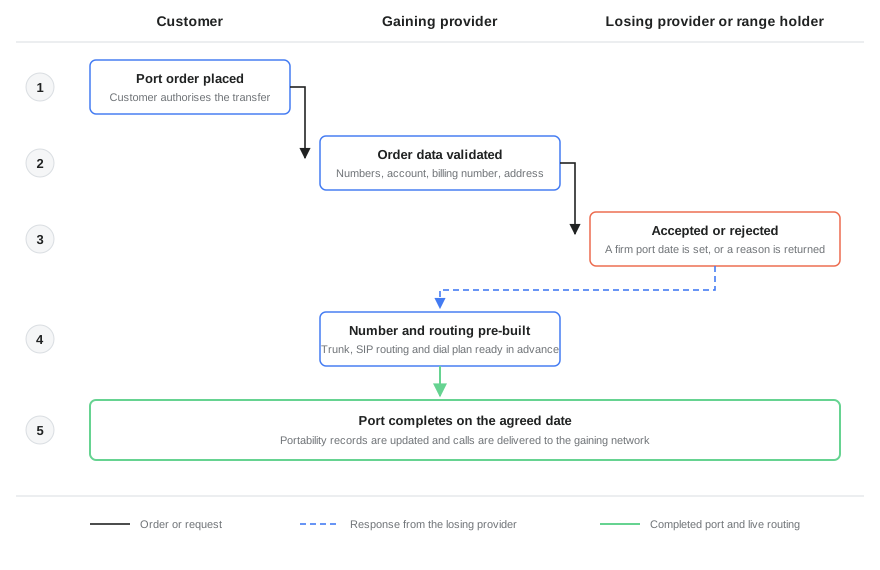
The port order lifecycle is broadly consistent across markets, even though the paperwork and the naming differ. A customer authorises the transfer, the gaining provider validates the order against the losing provider’s own record of the account, the losing provider accepts or rejects, a date is agreed, and the portability records are updated on that date.
Two details in that sequence deserve attention.
First, validation is checked against the losing provider’s record, not against reality. If your invoice shows a trading name and the carrier’s system holds a legal entity name, the order fails even though both are correct descriptions of your business. The same applies to the billing telephone number, the account number and the service address held on file.
Second, the gaining provider should build the number and its routing before the port date, not after it. If the number is already provisioned against a trunk and a dial plan, the cutover is a change of routing record rather than a provisioning task. didlogic’s porting portal follows this pattern: the number is pre-built in the control panel, and it rings to your PBX from the moment the port takes effect.
Who leads the process
Markets differ on who the customer has to talk to.
- Gaining provider led. The customer contacts only the new provider, which handles cancellation and coordination with the old one. Ofcom’s summary of Article 106 of the European Electronic Communications Code lists a gaining provider led process among its requirements. The United Kingdom launched its One Touch Switch process for residential landline and broadband customers on 12 September 2024 on this model.
- Authorisation code led. The customer obtains a code from the current provider and passes it to the new one. The code proves consent and ties the request to a specific account.
- Letter of authorisation (LOA) led. The customer signs a document, typically accompanied by a recent invoice. This remains the common pattern for business and wholesale ports in many countries, which is why electronic signature workflows matter so much for order turnaround.
How calls find a ported number
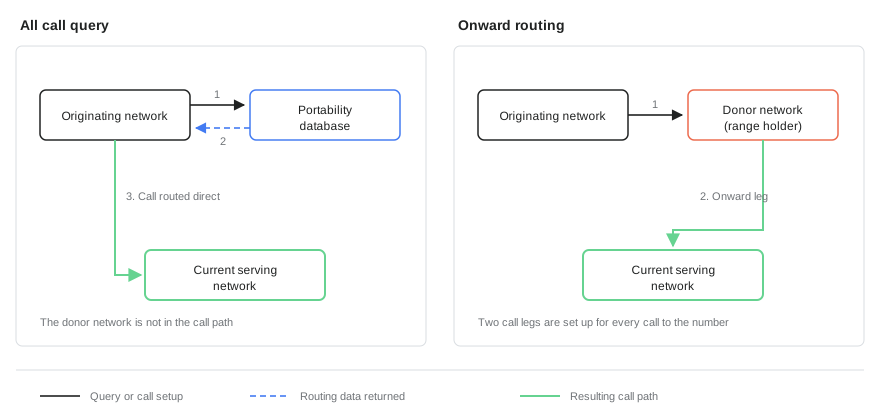
Once a number is ported, the digits no longer indicate which network serves it. Something in the call path has to translate the dialled number into a routing decision. RFC 3482 sets out four schemes used across the global switched telephone network, and every national implementation is a variation on one of them.
| Scheme | Where the lookup happens | Is the donor in the call path | Practical consequence |
|---|---|---|---|
| All call query (ACQ) | Originating network, before setup | No | Most efficient use of transmission; needs a shared database and query capability |
| Query on release (QoR) | Originating network, after the donor releases the call | Signalling only | An extra setup attempt before the call is routed correctly |
| Call dropback | Donor releases with routing information | Signalling only | Similar to QoR, with routing information returned on release |
| Onward routing (OR) | Donor network | Yes, for every call | Two physical call segments; permanent dependency on the donor network |
RFC 3482 notes that only all call query avoids involving the donor network altogether, and that onward routing is the least efficient of the four in its use of network transmission facilities. This is not an academic point. Where onward routing is in force, the network that originally held the range remains a single point of failure for a number it no longer serves, and Ofcom raised exactly this concern when it reviewed United Kingdom portability arrangements.
In the United States, responsibility for the query is assigned explicitly: the designated N minus 1 carrier must ensure the portability query is performed, where N is the entity terminating the call to the end user, unless another carrier has already done it.
What a ported number looks like in SIP
Once a portability lookup has produced an answer, that answer has to survive the rest of the call path. RFC 4694 defines the parameters that carry it in a tel URI, and they are commonly seen in SIP Request URIs between carriers:
rncarries the routing number retrieved from the portability database.npdiis the number portability database dip indicator. It tells downstream nodes that the lookup has already been performed.cicidentifies the carrier for freephone numbers.rn-contextdescribes how to interpret anrnvalue that is not in global format.
A Request URI for a ported number therefore often looks something like this:
INVITE sip:+442079460018;rn=<routing number>;[email protected] SIP/2.0RFC 4694 is prescriptive about the behaviour: a node that retrieves a routing number must add rn and must also add npdi, and a node that receives a URI already containing npdi must not repeat the lookup for a geographic number. Two engineering points follow. First, npdi is a loop prevention and duplication prevention mechanism, not decoration. Second, a URI arriving from an untrusted source may legitimately be re-dipped, so an incorrect or stale rn inserted upstream can either be corrected or cause the call to be released, depending on the receiving network’s policy.
If you are troubleshooting a ported number that rings on the wrong platform, or that fails only from certain originating carriers, these parameters are usually where the evidence is.
Timescales: what the rules actually require
Porting intervals are frequently misquoted because two different clocks get confused: the interval the carriers must meet once they hold a valid order, and the lead time a customer must give when submitting one.
United States. Carriers must complete a simple wireline to wireline or simple intermodal port request within one business day, unless a longer period is requested by the new provider or the customer. The order has to arrive in time: an accurate and complete Local Service Request must be received between 8am and 1pm local time to be eligible for activation at midnight the same day, and anything later counts as received at 8am on the next business day. Non-simple ports have a four business day interval. Only fourteen standard data fields may be required for a simple port, including the ported telephone number, account number, zip code, company code, new network service provider, desired due date and purchase order number. Interconnected VoIP providers must facilitate valid port requests without unreasonable delay or procedures that have the effect of delaying or denying the port. All of this sits in 47 CFR Part 52, Subpart C.
European Union. Article 106 of the European Electronic Communications Code gives end users with numbers from the national numbering plan the right to retain them on request, independently of the provider. It also requires that the right to port survives contract termination for at least one month, unless the end user renounces it, and that loss of service during a switch does not exceed one working day. National regulators set the detailed process on top of that.
United Kingdom. Ofcom’s General Condition B3 obliges providers to supply portability as soon as reasonably practicable and on reasonable terms, requires charges to be cost oriented, prohibits the donor provider from charging for porting system set-up costs or additional conveyance costs, and requires that networks used by either party do not cause a loss of service that would delay the port. Condition C7 governs the customer facing switching and porting experience.
Customer lead time is a separate number. A carrier interval of one business day does not mean a customer can submit an order today for tomorrow. didlogic’s porting guidance, for example, asks for a requested port date at least five business days after submission, which reflects validation, carrier acceptance windows and scheduling rather than the technical cutover itself. Build your migration plan around the lead time, not the interval.
Why ports get rejected, and how to prevent it
Rejections are almost always data problems, and they are almost always avoidable. Before submitting, confirm:
- The billing telephone number. This is the primary number that identifies the account to the losing carrier, and it is not necessarily the number you use most.
- The account number and legal entity name, exactly as the losing carrier holds them, including punctuation and abbreviations.
- The service address as registered, which may differ from your trading address.
- Whether the port is full or partial. A full port takes every number on the account and usually closes it. A partial port leaves some numbers behind, and if the billing telephone number is among those being moved, many carriers require it to be reassigned first.
- That no other order is pending on the account, such as a plan change or a previous port that was never cancelled.
- That the numbers are actually portable. Some number types and some ranges are excluded by national rules, and some numbers sit on a reseller chain where the losing party is not the entity you pay.
- A recent invoice, if the market uses a letter of authorisation model, since the invoice is the evidence that reconciles all of the above.
For mobile numbers in some markets, an account PIN or equivalent credential is also required. This is deliberate: the FCC now requires mobile carriers to use secure authentication methods reasonably designed to confirm a customer’s identity before effectuating a port out, and to train staff specifically on fraudulent port out attempts. Port out fraud is a real attack path against number-based account recovery, and the friction exists for a reason.
What to plan for around the cutover
- Have the routing built in advance. The number should be provisioned, mapped to a trunk and covered by a dial plan entry before the port date.
- Keep the old path alive briefly. Do not cancel the losing service the moment the port completes. Other systems may still reference it.
- Re-register the dependencies. Emergency service address records, messaging enablement, caller ID branding and directory listings live outside the port and need to be re-established on the new provider.
- Test inbound from multiple originating networks. A number that works from one mobile network and not another is usually a portability query or routing propagation issue, not a fault on your side.
- Expect a short propagation tail. Not every network refreshes portability data at the same instant, and calls from networks with stale data may take the old path briefly.
Where didlogic fits
didlogic provides the voice infrastructure layer: the numbers, the SIP trunking and the carrier routing that connect your PBX, contact centre, communications platform or application to the public telephone network. In a porting project, that means didlogic acts as the gaining provider, handles the order with the losing carrier and the relevant national process, and delivers calls to the ported number over SIP once the port completes.
Three parts of that are worth separating clearly:
- What didlogic does: submits and manages the port order, validates the order data before submission, pre-builds the number and its SIP routing so the number is configured ahead of the cutover, and terminates inbound calls to your trunk afterwards. In supported markets, port orders can be submitted, tracked and signed electronically through the LNP portal, which removes document round trips from the slowest part of the process.
- What the losing carrier controls: acceptance, rejection and the confirmed port date. No gaining provider can override a rejection caused by mismatched account data.
- What stays with you: your PBX or platform configuration, your dial plan, your applications and your routing logic on top of the trunk. didlogic supplies connectivity and numbering, not the application layer above it.
Scope, supported number types and the submission checklist are on the number porting page.
Frequently asked questions
Does porting a number cause downtime?
A well-executed port does not require a service outage, because the number is pre-provisioned on the gaining network and the cutover is a change of routing record. What causes visible disruption is usually configuration that was not ready in advance, or a dependency such as emergency registration that was never migrated. EU rules cap loss of service during a switch at one working day, which is a regulatory ceiling rather than a normal outcome.
How long does a port take?
The regulated carrier interval and the practical end-to-end time are different. In the United States a simple port must complete within one business day of a valid order, and a non-simple port within four. End to end, allow for validation, acceptance and scheduling: a lead time of about a working week is a realistic planning assumption for a straightforward business port, and longer for complex or multi-country migrations.
Can I port a number to another city or country?
Usually not. What is broadly mandated is service provider portability, which keeps a number at the same location while changing provider. Moving a number to a different geographic area is location portability, and most numbering plans do not permit it for geographic numbers because the area code carries meaning. Porting across countries is not available: a number belongs to a national numbering plan.
Can I port only some of my numbers?
Often yes, as a partial port. The complication is the billing telephone number: if it is included in the numbers being moved, the losing carrier may require it to be changed first, because that number identifies the account being kept open.
Why was my port order rejected?
The overwhelming majority of rejections come from a mismatch between the details you submitted and the details the losing carrier holds: account number, entity name, billing telephone number, service address, or an order already pending on the account. The fix is to reconcile against a recent invoice from the losing carrier and resubmit.
Do I own my phone number?
No. Numbers are a national resource. Regulators allocate ranges to communications providers, and providers may only use numbers allocated to them or that they are authorised to use by the allocation holder. What you hold is a right to use the number and a right to take it with you when you change provider.
Does porting move SMS, emergency calling or caller ID branding?
Not automatically. Voice porting and messaging enablement are separate processes in most markets, and emergency address registration, caller ID branding registrations and directory entries are provider-specific records. Treat each as its own migration task.
What is a range holder, and why does it matter after I have ported away?
The range holder is the provider to whom the number block was originally allocated. In markets that use onward routing, calls to your number are still delivered to the range holder first and then passed on to your current provider, which means the original network stays in the call path indefinitely. In markets using all call query, it does not.
Continue learning
