
A DID number, or Direct Inward Dialing number, is a telephone number that routes incoming calls directly to a specific user, extension, queue, PBX, application, or AI voice agent. The caller reaches the intended destination without going through a receptionist or shared main line.
Modern DID numbers are normally delivered over SIP. The carrier receives the call from the public telephone network, identifies the number that was dialed, and forwards the call to the destination configured by the number owner.
DID is the traditional telecom term. Virtual phone number is the broader commercial term commonly used for the same type of inbound-capable number. In Europe, DID may also be called DDI, or Direct Dial-In.
Quick facts
| Question | Short answer |
|---|---|
| What does DID stand for? | Direct Inward Dialing (DDI, or Direct Dial-In, in Europe) |
| What is it in practice? | A phone number that routes inbound calls straight to a chosen destination |
| Does it need a physical line? | No. Modern DIDs are virtual and delivered over SIP |
| What format does it use? | E.164, the international numbering standard (up to 15 digits) |
| Common destinations | PBX extensions, contact-center queues, softphones, mobile forwarding, voice applications |
| Common types | Local (geographic), national, mobile, toll-free |
| Who provides them? | Carriers and voice infrastructure providers such as didlogic |
Where the term comes from
Before VoIP, a company with 200 employees did not want 200 physical phone lines. Instead, it leased a block of numbers from the local telephone company and connected its PBX to the network through a smaller group of shared trunks, often ISDN PRI circuits.
When someone dialed an employee’s number, the telephone company delivered the call over one of those shared trunks and signaled which number had been dialed. The PBX read those digits and rang the matching extension. The caller reached a specific person directly, “dialing inward” past the switchboard. That signaling arrangement was the DID service.
The concept survived the move to IP telephony almost unchanged. A SIP trunk replaced the PRI circuit, and the dialed number now arrives in the SIP INVITE message instead of ISDN signaling. The routing logic is the same: many numbers, one shared connection, and the receiving system decides where each call goes.
How a DID works today
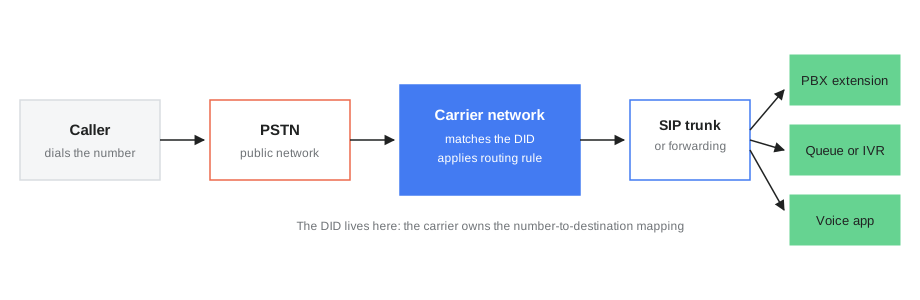
A modern DID involves four cooperating layers:
- The number itself. A DID is an entry in a national numbering plan, formatted according to E.164. It is assigned to a carrier, which makes it reachable from the public switched telephone network (PSTN).
- PSTN routing. When someone dials the number, the originating network looks up which carrier is responsible for it and delivers the call to that carrier’s network.
- Carrier-to-customer delivery. The carrier matches the dialed number against its records and forwards the call to the destination the customer configured. Over SIP, this means sending an INVITE to the customer’s SIP trunk, registered SIP device, or a forwarding target such as a mobile number.
- The receiving system. A PBX, contact-center platform, or voice application answers the call and applies its own logic: ring a desk phone, play an IVR menu, place the caller in a queue, or hand the audio to software.
The key relationship to remember: the DID identifies the destination, while the SIP trunk (or forwarding rule) transports the call to it. The number and the connection are separate things that work together.
DID number vs virtual phone number vs SIP trunk
A DID number, virtual phone number, and SIP trunk are related, but they are not the same component.
| Component | What it is | What it does |
|---|---|---|
| DID number | A telephone number assigned within a national numbering plan | Gives callers a number they can dial |
| Virtual phone number | A commercial term for a number that is routed without a dedicated physical line | Receives calls and forwards them to a configured destination |
| SIP trunk | The IP connection between a carrier and a PBX, contact center, or voice application | Transports calls and signaling |
| Extension | An internal identifier inside a PBX or communications platform | Routes the call after it reaches the customer’s system |
| Call forwarding | A routing rule that sends the incoming call to another telephone number | Provides delivery without requiring a SIP endpoint |
A DID identifies which number was called. The SIP trunk carries that call to the receiving system. One SIP trunk can therefore deliver calls for many DID numbers, while the PBX or application decides what should happen to each call.
For businesses that need numbers in multiple countries, virtual phone numbers provide the inbound identity, while SIP trunking provides the connection used to deliver calls.
DID vs the concepts it is confused with
DID vs phone number. Every DID is a phone number, but the term DID emphasizes the routing role: a number provisioned to deliver inbound calls directly to a configured destination. In everyday provider language, “DIDs” usually means inbound-capable virtual numbers sold individually or in blocks.
DID vs SIP trunk. These are the two halves of inbound calling and are frequently mixed up. The DID is the address people dial. The SIP trunk is the connection between the carrier and the customer’s system that carries the calls. One SIP trunk typically carries traffic for many DIDs, and a DID can be repointed from one trunk to another without changing the number.
DID vs extension. An extension is an internal identifier inside a PBX, such as 4021, and is not reachable from the outside world on its own. A DID is a public number. The classic setup maps a public DID to a private extension, which is exactly what the original telco feature was designed to do.
DID vs virtual number. In modern usage these largely overlap. “Virtual number” describes what the number is (not tied to a physical line or location), while “DID” describes what it does (delivers calls inward to a destination). Most providers, didlogic included, use the terms interchangeably for cloud-delivered numbers.
DID vs the device that answers. A DID is not the phone, the PBX, or the application. It is the addressing layer above them. This is why one DID can ring a desk phone today and a contact-center queue tomorrow with no change visible to callers.
A practical example
A software company based in Lisbon supports customers in Germany, the Netherlands, and Poland. Instead of publishing one Portuguese number, it provisions a local DID in each country: a Berlin number, an Amsterdam number, and a Warsaw number.
All three DIDs point to the same SIP trunk, which connects to the company’s contact-center platform. The platform reads which number was dialed and routes the call: German callers reach the German-speaking queue, Dutch callers the Dutch queue, and so on. Customers dial a familiar local number at local rates, while the team answering may sit anywhere.
The same pattern serves other cases: a distributed sales team giving each rep a direct number, a call-tracking setup assigning a distinct DID to each advertising campaign, or a multi-location business consolidating dozens of local numbers onto one platform.
What to check before ordering a DID
- Coverage and number type. Confirm the provider actually offers the country, city, and type (local, national, mobile, toll-free) you need. Availability varies significantly by market and is governed by national numbering rules.
- Documentation requirements. Many countries require identity verification, and some require a local address or business registration before a number can be activated. These are regulatory requirements, not provider preferences, and they differ per country and number type.
- Routing options. Check how the number can be delivered: SIP trunk, SIP registration, or forwarding to another phone number, and whether you can change the destination yourself.
- Capacity. Ask how many simultaneous calls the number supports and how that capacity is billed. Some providers charge per channel; others, including didlogic, bill per number and per minute without per-channel fees.
- Porting. If you already own numbers, confirm the provider can port them in, what documents are needed, and how cutover is handled so calls are not missed during the move.
- SMS. Voice and SMS are separate capabilities. A DID that receives calls does not automatically receive text messages, so verify SMS support separately if you need it.
- Caller ID behavior. If you also make outbound calls, check whether the DID can be presented as your outbound caller ID and what verification the provider requires first.
Common misconceptions
“A DID is a phone line.” It is not. A DID is a number and a routing entry. The transport is a shared SIP trunk or internet connection, and no dedicated physical circuit exists for the number.
“One DID means one call at a time.” Concurrency is a property of the trunk and the service plan, not the number. A single DID can receive many simultaneous calls if the connection behind it has the capacity.
“A local number proves local presence.” A country code or area code indicates where the number belongs in the numbering plan, not where the answering party is located. Regulators in some markets impose requirements precisely because of this distinction.
“DIDs are only for large PBX deployments.” The original telco feature was PBX-centric, but virtual DIDs now serve single-person businesses, contact centers, call-tracking platforms, hosted telephony providers, and voice applications of every size, including AI voice agents that answer calls delivered over SIP.
Where didlogic fits
didlogic operates the infrastructure layer of this picture: the carrier network that hosts the number and delivers the call. didlogic provides local DID numbers and virtual phone numbers in over 130 countries, along with the SIP trunking that carries inbound calls to a customer’s PBX, contact center, softphone, or voice application. Numbers can also be pointed at ordinary phones through call forwarding when no SIP endpoint exists.
What happens after delivery, such as IVR menus, queues, agent desktops, or conversational logic, belongs to the customer’s own platform. didlogic supplies the numbers and the connectivity underneath it; configuration steps for a new number are documented in the new number setup guide.
FAQs
Is a DID the same as a regular phone number?
From the caller’s perspective, yes: it looks and dials like any other number. The difference is in delivery. A DID routes inbound calls directly to a configured destination over shared trunks or the internet rather than terminating on a dedicated physical line.
Does a DID require a physical line?
No. Modern DIDs are virtual. The carrier delivers calls over SIP or forwards them to another number, so no copper pair, SIM card, or on-premises circuit is tied to the number.
Can one DID ring multiple places?
Yes, depending on the receiving system and provider features. A DID can point to a PBX that rings several extensions, or to carrier-side features such as call groups that ring multiple destinations simultaneously or in sequence.
How many DIDs can share one SIP trunk?
Many. The trunk is a shared connection, and the receiving system distinguishes calls by the dialed number carried in SIP signaling. Businesses commonly run hundreds or thousands of DIDs over a single trunk.
Can a DID receive SMS?
Sometimes. Voice and messaging are provisioned separately, and SMS support depends on the country, the number type, and the provider. Never assume a voice DID handles SMS without confirming it.
What is the difference between DID and DDI?
Nothing functional. DID (Direct Inward Dialing) is the North American term and DDI (Direct Dial-In) is the common term in Europe. Both describe the same capability.
Why are DIDs harder to get in some countries?
Numbering is nationally regulated. Some regulators require local identity documents, proof of address, or business registration before a number can be assigned, and inventory in certain cities or number types can be limited.
