
An alphanumeric sender ID is a short text string, normally up to 11 characters, that appears in place of a phone number as the originator of an SMS. It is not a number, it cannot receive replies, and in a growing list of countries it can no longer be chosen freely. Ireland, Spain, Italy, Singapore, Australia, India and the United Arab Emirates all now require the sender ID to be registered and tied to a verified legal entity before messages carrying it will be delivered normally.
The pattern behind the rules is consistent even though the mechanics differ. Regulators concluded that a freely settable sender field was the main enabler of smishing, because a scammer could put a bank’s name in the originator field and have the message thread itself alongside that bank’s genuine texts on the recipient’s handset. The response has been to make the sender ID a registered identifier with a verifiable owner. What varies between countries is who holds the registration, who enforces it, and whether an unregistered sender is relabelled or simply dropped.
Quick facts
| Question | Short answer |
|---|---|
| What is it? | A text string in the SMS originating address field, shown to the recipient in place of a number |
| How long can it be? | Normally 11 characters, a limit that comes from the GSM address field encoding |
| Can recipients reply? | No. Alphanumeric senders are one way only |
| Is it supported everywhere? | No. The United States and Canada do not support it for A2P traffic at all |
| Who registers it? | Depends on the market: the brand, its messaging provider, or both |
| What happens if it is not registered? | Relabelling to a warning string, rewriting to a number, or blocking, depending on the country |
| Does one registration cover several countries? | No. Registration is per market, and in some markets per provider as well |
| Is it the same as caller ID? | No. Caller ID applies to voice calls and follows different rules entirely |
What an alphanumeric sender ID actually is
In a mobile-originated text the originator is a phone number. In an application-originated text the same field can instead carry a short string of letters and digits. The field is defined in the GSM short message specifications, and the address is encoded using the GSM 7-bit default alphabet. That encoding, applied to the fixed size of the address field, is where the familiar 11-character ceiling comes from. It is a protocol constraint, not a carrier preference, which is why it shows up identically in vendor documentation and in national registry rules.
Three consequences follow directly from the design.
It is one way. There is no number behind the string, so there is nothing for a handset to send a reply to. A message from “ACMEBANK” cannot be answered. Anything that depends on a reply, including keyword opt-out, has to be handled another way: a short code named in the message body, a link, or a separate two-way number.
It carries no location. A sender ID has no country code and no numbering plan behind it. Nothing in the string tells the receiving network where the traffic originated, which is precisely the property regulators are now trying to compensate for.
It is not reserved by default. Historically any sender could put any string in the field. Two unrelated companies could use the same one on the same network in the same week. Registration is what turns the string into something with an owner.
Character sets are narrower than the alphabet suggests. Most markets accept A to Z, a to z and 0 to 9. Support for spaces and punctuation varies: Ireland’s registry permits certain characters including space, hyphen and comma, while several Gulf markets accept a small set of punctuation and reject spaces. A sender ID consisting only of digits is treated as a numeric sender in most regimes, which puts it under different rules again.
Three checks decide whether a sender ID survives
When a message reaches a destination network, the sender ID is subject to a series of tests. Most delivery problems that senders describe as “the sender ID stopped working” are one of these three failing, and each one is applied independently of the others.
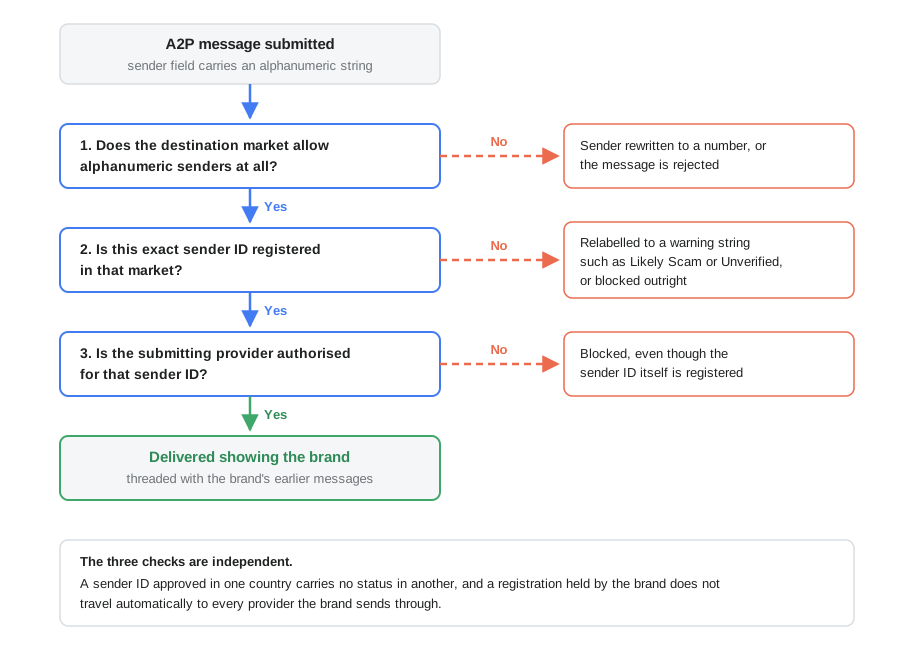
The third check is the one teams most often miss. In Spain and Ireland, registration links a sender ID not only to an owner but to the specific providers permitted to submit traffic for it. A brand that registers its alias and then routes a campaign through an additional aggregator, without adding that aggregator to the authorisation, will see the campaign blocked despite holding a valid registration. This provider chain is a deliberate design feature. It closes the route by which a scammer could otherwise submit traffic claiming a legitimately registered brand name.
Four regulatory models, and how markets move between them
Every national regime falls into one of four categories.
| Model | How it works | Examples |
|---|---|---|
| Not supported | Alphanumeric senders are not carried for A2P traffic. Branding lives in the message body and in a consistent sending number | United States, Canada |
| Open | Alphanumeric senders work without prior registration, though carriers still filter | Much of Europe outside the registry markets |
| Protective registry | Registration is optional, but a registered sender ID is protected: nobody else may use it | Singapore’s registry during its first year, the UK industry registry |
| Mandatory pre-registration | Unregistered senders are relabelled or blocked | Ireland, Spain, Italy, Singapore, Australia, India, UAE |
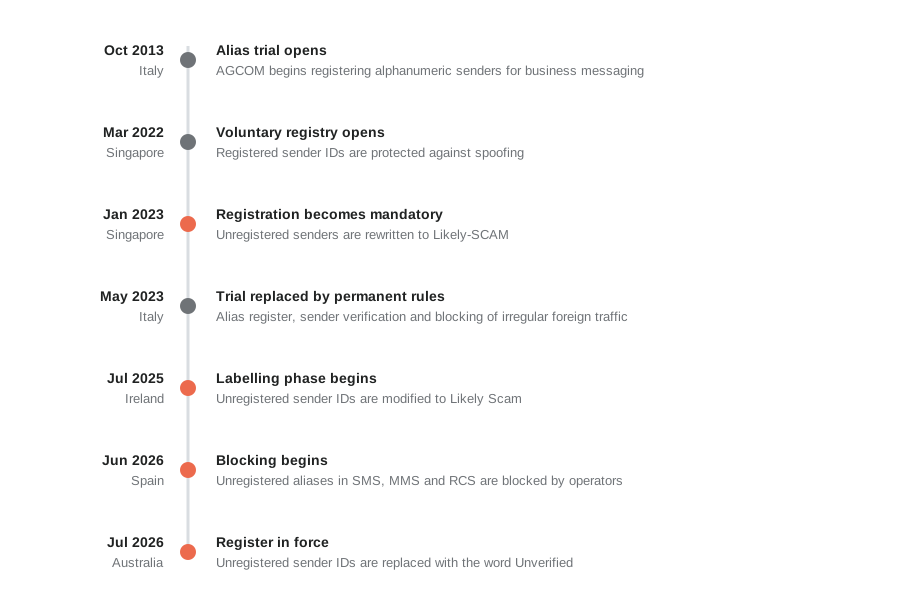
Markets rarely jump straight to the last row. The usual sequence is a protective registry first, then a labelling phase in which unregistered senders are rewritten to a warning string, then blocking. The labelling phase serves two purposes: it warns consumers, and it gives legitimate senders a visible, embarrassing signal that they have not registered yet. That sequence has now repeated in several countries, and almost all the movement has been in one direction.
At European level the work has been formalised. The Electronic Communications Committee within CEPT has produced ECC Recommendation (25)04 on measures to handle alphanumeric SMS sender IDs, which gives national regulators a common reference for the kind of regime Spain and Ireland have built. Expect more European markets to follow the same shape rather than invent new ones.
Europe: Ireland, Spain, Italy and the United Kingdom
Ireland operates the most closely watched of the recent registries. The Commission for Communications Regulation runs the SMS Sender ID Registry under its Decision D14/24. Since 3 July 2025, messages from unregistered sender IDs have been modified to “Likely Scam” before delivery. Blocking was scheduled for 3 October 2025 but ComReg deferred it while industry participants worked through technical issues, so the labelling requirement remains the operative sanction. As of ComReg’s 20 August 2026 update the registry held 21,569 registered sender IDs across 15,923 registered owners. Registration is submitted through participating aggregators, and the registry covers alphanumeric sender IDs only: certain numeric short codes may be registered by the code holder, and ordinary mobile numbers need no registration at all.
Spain went further and went straight to blocking. The Comisión Nacional de los Mercados y la Competencia created a national alias register through Circular 1/2026, adopted on 18 March 2026 under Order TDF/149/2025, with blocking obligations fully applicable from 7 June 2026. Three features make the Spanish regime the strictest currently in force in Europe. It covers SMS, MMS and RCS rather than SMS alone. It requires prior registration, meaning an alias cannot be used until its entry is effective. And it obliges operators to block not only unregistered aliases but registered aliases arriving from a provider not authorised for them. Purely numeric senders are outside its scope. The CNMC also publishes a public lookup so anyone can check which aliases are registered and to whom.
Italy has the longest history. AGCOM began registering alphanumeric aliases as a trial in October 2013 and replaced the trial with permanent rules in delibera 12/23/CIR of 3 May 2023, which established the alias register alongside the national numbering plan. The Italian framework pairs alias registration with an obligation to block irregular messaging arriving from abroad, and it restricts alias use to non-consumer entities holding an Italian tax identity. A foreign company sending to Italian mobile numbers with an alphanumeric sender is inside the scope of the rules.
The United Kingdom takes the industry rather than the regulatory route. The Mobile Ecosystem Forum operates the SMS SenderID Protection Registry, a cross-industry scheme in which brands protect their sender IDs and participating operators block traffic that attempts to use a protected ID without authorisation. It functions as a protective registry rather than a mandatory one: an unregistered sender ID is not automatically labelled, but a sender ID belonging to a protected brand will not get through without an authorisation on file. In practice most UK aggregators now expect a letter of authorisation before enabling a branded sender.
Asia Pacific: Singapore, Australia and India
Singapore was the first market to make registration mandatory with a hard consequence. The registry is operated by the Singapore Network Information Centre on behalf of IMDA. Under the full SSIR regime, from 31 January 2023 organisations sending SMS with alphanumeric sender IDs to Singapore mobile users must register those sender IDs and must send only through participating aggregators licensed by IMDA. Unregistered sender IDs were rewritten to “Likely-SCAM” during the transition. Two details catch foreign senders out. Registration requires a Singapore Unique Entity Number, which an overseas business obtains by registering with ACRA. And the registry charges: SGNIC lists a one-time account set-up fee of S$545 and an annual listing fee of S$218 per sender ID, inclusive of GST. Sender IDs are allocated first come, first served, so a brand that delays may find its own name taken.
Australia is the most recent. The Australian Communications and Media Authority’s SMS Sender ID Register came into force on 1 July 2026 under the Telecommunications (SMS Sender ID Register) Industry Standard 2025. Messages sent with an unregistered sender ID have the sender ID replaced with the word “Unverified”, and those messages are grouped into a single thread on the handset rather than appearing alongside the brand’s genuine messages. Telcos that carry sender ID traffic must themselves apply to participate; messages from non-participating providers are blocked. ACMA requires the sender ID to relate clearly to the registering entity: the organisation’s name, a shortened form, an acronym, or the name plus a word describing function or purpose. Registration for an ABN holder depends on the authorised contact details in the Australian Business Register being current, which is a common cause of stalled applications.
India runs the most demanding regime of any market, and it is structurally different from the others. Under the Telecom Commercial Communications Customer Preference Regulations, the Telecom Regulatory Authority of India requires commercial senders to register on a distributed ledger platform operated by an Indian telecom operator. Three things must be registered, not one: the principal entity, the header (India’s term for the sender ID), and every content template. Headers are six characters rather than eleven, and the routing category matters, with alphanumeric headers used for transactional and service traffic and numeric headers for promotional traffic. Since May 2025 telecom operators append a category suffix to the header during scrubbing, so a service message from header ABCXYZ reaches the handset as something like AD-ABCXYZ-S, where the trailing letter marks the message as promotional, service, transactional or government. A message whose body does not match its registered template is dropped silently, which is why India accounts for a disproportionate share of “sent but never arrived” investigations.
Middle East: operator-level approval
The Gulf markets generally place approval at operator level rather than in a central registry, which changes the shape of the work rather than its difficulty.
In the United Arab Emirates, sender IDs are registered with each mobile network separately, and the sender name is expected to match the registered company name or trademark. The rule that surprises most first-time senders is the promotional prefix: marketing messages must carry “AD-” ahead of the sender name, so a brand registered as ACMELOGISTIC must submit promotional traffic as AD-ACMELOGISTIC. Numeric senders are not used for commercial A2P traffic. Certain categories, including health, financial and education services, need sector approvals in addition to the telecom registration. The UAE applies comparable identity discipline on the voice side, described in UAE caller ID allowlisting.
In Saudi Arabia, A2P traffic is expected to run through aggregators licensed by the Communications, Space and Technology Commission, with sender names approved before use. Requirements in the region change more often than in Europe, so the correct step before a launch is to confirm the current position with the provider that will actually submit the traffic rather than to rely on a published summary.
North America: no alphanumeric senders
Neither the United States nor Canada supports alphanumeric sender IDs for A2P messaging. Traffic runs on registered 10-digit long codes, verified toll-free numbers, or short codes, all of which are numbers and all of which have their own registration process. This is worth stating plainly because it inverts the usual assumption: in North America, brand recognition has to come from the message body and from consistent use of the same sending number, and a sender ID that works well elsewhere simply has no equivalent. Platform behaviour differs on what happens to a message submitted with an alphanumeric sender for a US destination, with some providers substituting a number and others rejecting the submission.
Country comparison
| Market | Regime | Registration held by | Unregistered sender ID |
|---|---|---|---|
| Ireland | Mandatory, regulator-run | Brand, submitted via participating aggregator | Modified to “Likely Scam”; blocking deferred |
| Spain | Mandatory, regulator-run | Brand, linked to authorised providers | Blocked since 7 June 2026 |
| Italy | Mandatory, regulator-run | Business entity with Italian tax identity | Not deliverable as an alias |
| United Kingdom | Protective industry registry | Brand, via provider with letter of authorisation | Delivered unless it clashes with a protected ID |
| Singapore | Mandatory, registry plus licensed aggregators | Entity holding a Singapore UEN | Rewritten to “Likely-SCAM” |
| Australia | Mandatory, regulator-run | Entity, normally an ABN holder | Replaced with “Unverified” |
| India | Mandatory, three-layer DLT | Principal entity on a DLT platform | Blocked; template mismatch also blocked |
| UAE | Mandatory, operator-level | Entity, registered on each network | Not approved; promotional needs AD- prefix |
| United States | Alphanumeric not supported | Not applicable | Not applicable |
| Canada | Alphanumeric not supported | Not applicable | Not applicable |
Other markets, including several in the Middle East, North Africa and South Asia, operate registration requirements of their own. Treat the absence of a country from this table as a prompt to check rather than as evidence that no rules apply.
What a registration application actually asks for
The paperwork is more consistent than the regimes. Nearly every registry wants the same four things.
Proof of the legal entity. A company registration number, a national business identifier, or the local equivalent. Several markets require a domestic identifier specifically, which is why Singapore registration begins with obtaining a UEN and Italian alias registration assumes an Italian tax identity.
Proof of the connection between the entity and the string. This is the part that fails most often. The sender ID has to be traceable to the applicant’s registered name, trading name, trademark or domain. “ACME” registered by Acme Ltd is straightforward. A campaign name, a product nickname or a generic word normally is not, and where the link is not obvious the regulator may ask for trademark evidence.
The provider chain. Which aggregator or originating provider will submit traffic for this sender ID. In Spain and Ireland this is part of the registration itself, not an implementation detail.
A description of the use case. What the messages say, roughly how many there will be, and which regulated sector the sender operates in, since health, finance and education frequently attract additional approvals.
Timelines vary widely by market and by how busy the registry is. Plan the registration before the campaign schedule rather than alongside it, and treat any date given by a provider as an estimate rather than a commitment.
What gets a sender ID rejected
- Generic words. INFO, ALERT, VERIFY, SMS, NOTIFY and similar strings are rejected in most registries because they cannot be tied to an owner and because scammers favour them.
- Strings that do not match the entity. A shortened form of the registered name is normally accepted. A slogan or an unrelated campaign name normally is not.
- Impersonation risk. Anything resembling a bank, a government service, a delivery company or a well known brand the applicant does not own.
- Restricted characters. Spaces and punctuation are accepted in some markets and rejected in others. Assume letters and digits only unless the registry says otherwise.
- Case mismatches. Some registries treat the registered string as exact. Sending ACMEBANK when AcmeBank is registered can fail.
- Numeric-only strings. These usually fall outside the alphanumeric regime and into number rules instead.
Mistakes that cause most sender ID failures
Assuming one registration travels. A sender ID registered in Ireland has no standing in Spain, Singapore or Australia. Each market is separate, and in the newer regimes each provider relationship is separate too.
Registering the brand but not the variants. Teams frequently register the main sender ID and then send OTP traffic from a slightly different string. The variant is a different sender ID and needs its own entry.
Adding a provider without updating the authorisation. Adding a second aggregator for redundancy is a sound engineering instinct and, in Spain and Ireland, a fast route to blocked traffic if the registration is not updated first.
Relying on replies for opt-out. An alphanumeric sender cannot receive a reply, so a message that says “reply STOP” is instructing the recipient to do something impossible. Markets that require an opt-out mechanism expect a short code, a link, or a separate number.
Testing only in an open market. A campaign validated against a country with no registry proves nothing about a market with one. Test each destination separately.
Treating registration as a deliverability guarantee. Registration establishes identity. Filtering on content, volume and consent still applies on top, in the same way that a clean number does not exempt a voice campaign from caller ID reputation scoring.
Where didlogic fits
didlogic operates at the carrier layer for A2P SMS, routing messages over direct carrier interconnects rather than through public aggregators. In sender ID terms that means two options on the outbound side: an SMS-enabled didlogic number as the sender, or an alphanumeric sender ID where local rules permit one, subject to the verification each destination requires. didlogic’s own documentation is explicit that some countries prohibit dynamic or unregistered sender IDs, and the platform provides per-region guidance on compliant sender configuration alongside A2P registration guidance where a market requires it. Achievable throughput also depends on the destination’s rules and on which sender type is used, which is one reason the sender decision belongs at the start of a deployment rather than the end.
Configuration itself is straightforward: SMS is enabled per number, sender IDs are set in account settings, and inbound messages are delivered to a webhook, as described in the SMS gateway setup documentation.
What stays with the sender is everything the registry is actually testing. The legal entity, the evidence linking that entity to the string, consent and opt-out handling, and message content remain the sender’s responsibility, and in several markets the regulator requires the brand itself to hold the registration rather than its provider. A carrier can submit the application, name itself in the provider chain and route the traffic correctly. It cannot supply the identity the registry exists to verify.
FAQs
How long can an alphanumeric sender ID be?
Normally 11 characters. The limit comes from the size of the originating address field and the GSM 7-bit encoding used for it, not from carrier policy. India is the notable exception in the other direction: DLT headers are six characters.
Can someone reply to a message sent from an alphanumeric sender ID?
No. There is no number behind the string, so the handset has nothing to reply to. Anything requiring a response, including keyword opt-out, needs a number or short code named in the message.
Do I have to register in every country I send to?
Only in the markets that require it, but that list is growing and each registration is separate. Check per destination before launch rather than assuming a registration in one market carries over.
What happens if I send with an unregistered sender ID?
It depends on the market. Ireland modifies it to “Likely Scam”. Australia replaces it with “Unverified”. Singapore rewrote unregistered senders to “Likely-SCAM” during its transition. Spain blocks the message. India blocks unregistered headers outright.
Can two companies register the same sender ID?
Registries generally allocate on a first come, first served basis and require evidence linking the applicant to the string, so in practice one entity holds it in a given market. This is a reason to register a brand name before you need it, not after.
Can I use an alphanumeric sender ID for the United States?
No. The United States and Canada do not support alphanumeric senders for A2P messaging. Use a registered 10-digit long code, a verified toll-free number, or a short code.
Does registration guarantee delivery?
No. Registration establishes who owns the sender ID. Operators still filter on content, volume, consent and reputation, and a registered sender ID sending unwanted traffic will still be filtered.
Is a sender ID the same thing as caller ID?
No. They occupy similar positions on a handset but sit in different systems with different rules. Caller ID applies to voice calls, is a number rather than free text in most jurisdictions, and is governed by separate regulation.
Continue learning
