
AI cold calling is outbound calling in which a synthetic voice agent, rather than a human agent, conducts the conversation with the person who answers. The AI handles speech recognition, dialogue and speech synthesis. Everything else is ordinary telephony: a number to present as caller ID, a SIP trunk to carry the call, a carrier to route it, and a terminating network that decides whether the phone rings at all. The AI changes who speaks. It does not change what the network requires, and in several respects it makes those requirements harder to meet.
The parts that break in practice are rarely the model. They are the moment of answer, the caller ID you present, the capacity your trunk is provisioned for, and the consent and disclosure rules that attach specifically to automated voices.
AI cold calling at a glance
| Question | Short answer |
|---|---|
| What is it? | Outbound calling where a synthetic voice agent conducts the conversation in real time |
| What carries the call? | A SIP trunk and a carrier voice route, exactly as for a human dialler |
| What identifies the caller? | A phone number presented as caller ID, which the calling party must be authorised to use |
| Hardest technical moment | Detecting a real answer and starting audio without clipping the greeting |
| Hardest regulatory point | An automated voice usually triggers stricter consent rules than a live agent |
| Who provides what? | The AI platform provides the conversation. The voice provider provides numbers, trunking and routing |
| Main failure mode | Calls that are answered by nothing, labelled as spam, or never delivered at all |
What AI cold calling is, and what it is not
An AI cold call has three distinct components that are often collapsed into one.
The conversation layer is the model stack: speech recognition, a language model, dialogue policy, and text to speech. This is what people mean when they say “AI voice agent”.
The campaign layer is the orchestration around it: the contact list, the dialling logic, retry rules, suppression lists, consent records and outcome logging. This is a dialler, whether or not it is called one.
The network layer is the voice infrastructure: a phone number, a SIP trunk, carrier routing, and interconnection to the public telephone network. This layer does not know or care that the party on your side is a model.
AI cold calling is not the same thing as a prerecorded robocall, and it is not the same thing as a predictive dialler that connects answered calls to human agents. It shares a problem with each. Like a robocall, it presents an artificial voice, which is the trigger for the strictest consent rules in several jurisdictions. Like a predictive dialler, it places calls at machine speed, which is the trigger for carrier scrutiny and analytics-based labelling.
It also removes one classic problem. A predictive dialler abandons calls when it over-dials and no human agent is free. An AI agent is always free, so agent-availability abandonment goes to zero. That is a real improvement, and it is the reason the technique is attractive. It does not remove any of the other constraints.
How an AI cold call is placed, step by step
- The campaign layer selects a contact and checks it against do-not-call registries, internal suppression lists and any consent record required for the destination.
- It selects a caller ID to present. This must be a number the calling party is entitled to use, and in most markets it must be dialable back to a real destination.
- It issues a call request to the voice platform, which sends a SIP
INVITEtowards the carrier, carrying the destination number in E.164 form and the presented caller ID in theFromandP-Asserted-Identityheaders. - The originating carrier applies its own checks: is this customer authorised for this number, is the destination permitted, is the calls-per-second rate within the agreed limit.
- The call is routed to a terminating carrier in the destination country, which may apply caller ID authentication checks and call analytics.
- If the call is delivered, the destination handset rings. The originating side sees
180 Ringing, or183 Session Progressif early media is being supplied. - When the called party picks up, the terminating side sends
200 OK. Two way audio begins, billing starts, and the AI agent finally has something to listen to. - The agent classifies what it hears, speaks, converses, and the call ends with a
BYEfrom one side or the other. The outcome is written back to the campaign layer, and the whole chain runs again for the next number.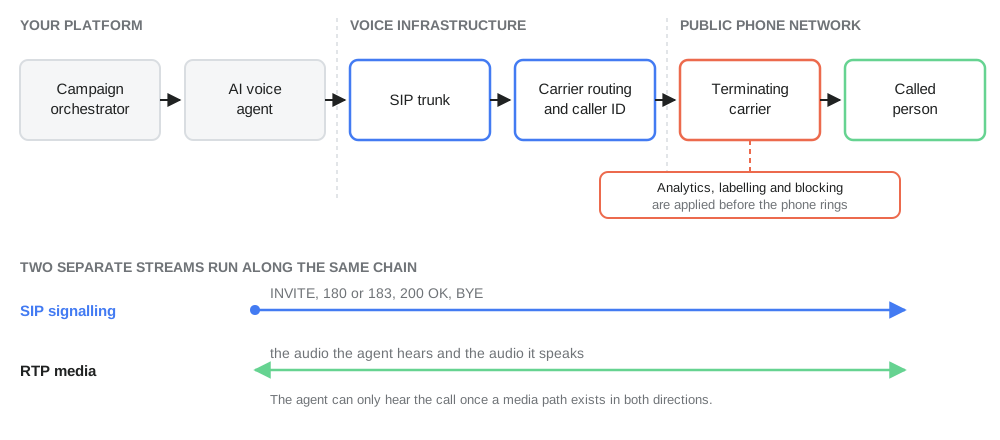
Why the moment of answer is the hardest part
Everything before 200 OK gives the agent no information. 180 Ringing carries no media at all. 183 Session Progress may carry early media, which is defined in RFC 3960, but early media is ringback, a network announcement, or an intercept tone. It is not a person. An agent that treats early media as an answer starts talking over a ringing tone and burns its opening line.
Then 200 OK arrives, and the agent has to answer three questions almost simultaneously: is this a person, is it a voicemail greeting, or is it nothing at all. A human agent does this without thinking. A model has to do it from a few hundred milliseconds of audio, while its own first utterance is already being synthesised, and while the end-to-end latency budget is already being consumed by network transit before there is anything to listen to.
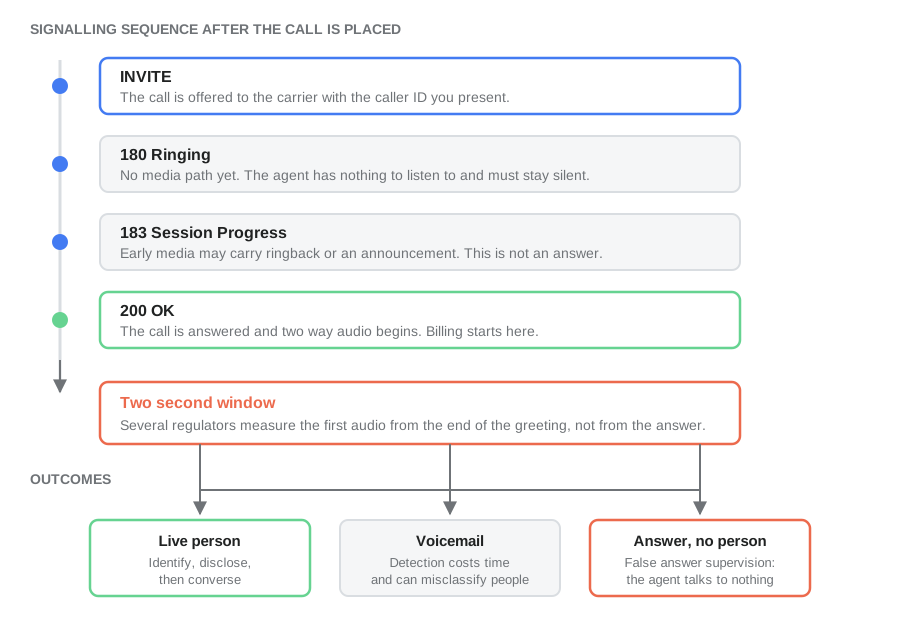
The third outcome deserves its own name. False answer supervision is the practice, seen on some low-quality wholesale routes, of returning an answer signal when no call has actually been completed. The originating side sees 200 OK, billing starts, and the media path contains silence, a tone, or a looped announcement. A human agent hangs up within a second or two. An AI agent will deliver its entire opening script into nothing and may keep the session open for its full configured timeout. On a large campaign this is a measurable cost line, and it is invisible unless you look at the distribution of call durations rather than the average.
The practical signals that separate a genuine answer from a false one are: an implausibly short interval between INVITE and 200 OK, answered calls clustering at a single duration, near-identical audio energy profiles across many calls, and an answer-seizure ratio that is far higher than the destination normally supports. Any of these on a specific route is a reason to move the traffic.
The two-second rule that sets your first-audio budget
Most engineering discussion of AI voice latency frames the first-response time as a user experience question. For outbound calling, in at least two significant jurisdictions, it is also a compliance question, and the clock starts in a place engineers often get wrong.
Under the United States rules at 47 CFR 64.1200, a telemarketing call is treated as abandoned if it is not connected to a live sales representative within two seconds of the called person’s completed greeting. Where the caller holds prior express written consent and delivers an artificial or prerecorded voice message instead, the call is not treated as abandoned provided the message begins within two seconds of the completed greeting. The same rules cap abandonment at three per cent of live-answered telemarketing calls per campaign over a 30-day period, and prohibit disconnecting an unanswered call before 15 seconds or four rings.
In the United Kingdom, Ofcom’s statement of policy on persistent misuse applies a similar two-second measure from a slightly different anchor. Where the technology classifies the call by recognising voice or sound, the two seconds run from the point the person begins to speak. In any other case they run from the point the phone is picked up. Ofcom also treats calls terminated before 15 seconds of ringing as more likely to cause harm, and, since the 2016 revision that took effect on 1 March 2017, it no longer publishes a three per cent abandoned call rate as a prioritisation criterion. There is no safe harbour figure.
The consequence for an AI cold calling system is specific. The budget is not “time from 200 OK to first token”. It is “time from the end of the called person’s greeting to first audible word”, and it includes voice activity detection, endpointing, any answering machine classification you run, first-token latency from the model, and speech synthesis buffering. Endpointing thresholds that feel generous in a demo can consume most of the window on their own, because the system has to wait to be confident the person has finished saying “hello” before it decides to speak.
Two seconds is also the outer edge of natural conversation, not a comfortable target. Treat it as the regulatory ceiling and design to a lower internal figure, measured end to end from the far side of the greeting rather than from your own application logs.
Answering machine detection trades one problem for another
Answering machine detection classifies the audio after answer to decide whether a human or a voicemail system picked up. For outbound AI campaigns it looks essential: leaving a message costs money and achieves little, and a conversational agent talking to a voicemail greeting produces nothing usable.
It introduces two costs.
The first is latency. Any classifier that listens before allowing the agent to speak spends part of the two-second window. Detection accuracy generally improves with more audio, so accuracy and responsiveness pull in opposite directions.
The second is misclassification, and it is the more serious one. A false positive means a real person is classified as a machine and the call is dropped. From the recipient’s side that is a silent call. Ofcom treats silent calls as its highest enforcement priority and states explicitly that answering machine detection may generate them by mistaking a call recipient for an answer machine. Where an organisation uses automated calling systems or answering machine detection, Ofcom expects records including the type of technology in use, detailed call records and evidence of the detection accuracy, kept for at least six months.
Ofcom’s own abandoned call rate formula makes this concrete. Silent calls, unconnected calls and calls to answer machines are all excluded from the denominator, so the calculation isolates calls answered by a live individual. A campaign cannot improve its position by dropping more calls before a person has a chance to speak.
The design conclusion is that detection should generally run in parallel with a compliant opening, not in front of it. Speak the identification within the window, continue classifying, and disconnect cleanly if the evidence resolves to voicemail. That is harder to build than a gate, and it is the difference between a silent call and a short one.
Caller ID, attestation, and why some calls never ring
The number you present does more work than any other single variable in an outbound campaign.
Authorisation comes first. In the UK, Ofcom’s persistent misuse policy lists as misuse the withholding of caller ID on marketing calls, displaying a caller ID that is not authentic or valid, displaying one that is unreturnable when dialled, and displaying a premium rate number. It also addresses the use of multiple numbers directly. Using several numbers can be legitimate, for example to route return calls to the right location or team. It becomes misuse where the evidence shows recipients are being misled about who is calling or where the caller is, or where the pattern is being used to avoid detection and complaints. The distinction is intent and effect, not the number of numbers.
Authentication comes second, where it exists. In the United States and Canada, calls originating on IP networks are signed under the STIR/SHAKEN framework. The three attestation levels are defined in ATIS-1000074 and described in the FCC’s own orders. Full or A-level attestation requires that the signing provider originated the call, has a direct authenticated relationship with the customer and can identify them, and has established a verified association with the telephone number used. Partial or B-level attestation drops the number association. Gateway or C-level attestation asserts only that the provider is the point of entry for a call that originated elsewhere. This does not exist in most other countries, so do not assume it travels with your traffic across borders.
Analytics come third, and they are the part nobody controls. Terminating carriers and third-party analytics engines score inbound calls and apply labels such as “Spam Likely”, or block them outright. Attestation is one input among many. Call volume, duration distribution, answer rates, complaint rates and the age of a number all feed the score. Our guide to caller ID reputation and spam labelling covers the mechanics in detail.
There is a useful diagnostic here that most teams miss. Under the FCC rules, a terminating provider that blocks calls based on an analytics program must return a specific response code to the origination point: SIP 603+ as defined in ATIS-1000099 for calls terminating on an IP network, or ISUP code 21 with the cause location “user” on a non-IP network. If your campaign’s failure codes show a cluster of 603 responses, that is analytics-based blocking rather than a busy or unavailable subscriber, and the fix is reputation and number hygiene rather than retry logic. Our SIP response code reference sets out the full mapping.
The rules also require terminating providers that block calls or use caller ID authentication information to publish a single point of contact for blocking error complaints, to resolve disputes within a reasonable time with a status update within 24 hours, and to stop the treatment promptly when a caller makes a credible claim of erroneous blocking that the provider confirms. If your numbers are being mislabelled, there is a defined remediation route.
Capacity: calls per second, concurrent channels, and short-duration traffic
An AI campaign consumes two different resources, and they are provisioned separately.
Calls per second (CPS) is the rate at which new call attempts are offered to the trunk. Carriers set CPS limits because signalling load, not media load, is what overwhelms switches. Exceeding the agreed rate produces 503 Service Unavailable responses that look like route failure but are rate limiting.
Concurrent channels is the number of calls that can be in progress simultaneously. This is driven by average call duration, not by attempt rate. An AI campaign with longer conversations than a comparable human campaign needs more channels for the same number of attempts.
The two interact in a way that surprises teams migrating from human agents. Because an AI agent is always available, connect rates rise, so concurrency rises faster than expected while CPS stays flat. Provisioning based on last quarter’s dialler numbers will usually understate the channel requirement.
There is also a commercial dimension. Short-duration and dialler-style traffic has historically attracted surcharges and penalties from carriers, because calls that do not complete still consume terminating network resources without generating revenue. Some networks do not accept dialler traffic at all. This is why outbound campaigns are normally quoted after a traffic profile review rather than from a standard rate card, and why the destination mix in your list can change the price of the route.
The audio path: codecs, DTMF and warm transfer
Three practical points determine whether the conversation actually works once it is connected.
Codec and transcoding. Most public network interconnection still runs on G.711, and a call that reaches a mobile handset over a legacy path is narrowband regardless of what your platform negotiated. Wideband audio only survives where the entire path supports it. Each transcoding step adds delay and degrades the signal that your speech recognition has to work from. Where you can negotiate a single codec end to end, do so. Our voice codec guide covers the trade-offs.
DTMF. Outbound calls frequently land in an automated attendant before reaching a person. If the agent needs to navigate a menu or capture a keypress, DTMF must be carried correctly. RFC 4733 defines the standard telephone-event payload for carrying tones in RTP. Mismatched DTMF methods between your platform and the carrier are a common cause of agents that appear to work in testing and silently fail against real business phone systems.
Transfer. Handing a qualified conversation to a human is the point of most AI cold calling programmes. The clean mechanism is SIP REFER, defined in RFC 3515, which moves the call rather than bridging two legs together. Bridging works but doubles channel consumption for the duration of the transfer and adds a media hop. Confirm which method your carrier supports before designing the handover, because support is not universal.
The metrics that tell you where a campaign is failing
Two families of metric matter, and one term means different things in each.
Route quality metrics describe what the network is doing. Answer-seizure ratio, defined in ITU-T Recommendation E.411, is the proportion of call attempts that result in an answer signal. It is the standard wholesale quality figure, but it mixes network performance with human behaviour, since a person choosing not to answer counts as a failure. Network effectiveness ratio, defined in ITU-T Recommendation E.425, counts answers, user busy, ring no answer and terminal rejection as successes, which isolates network performance from recipient behaviour. Average call duration and post-dial delay complete the picture.
Note the ambiguity carefully. In carrier and routing discussions, ASR means answer-seizure ratio. In AI voice discussions, ASR usually means automatic speech recognition. On an AI cold calling project both appear in the same conversation, and confusing them produces genuinely misleading conclusions.
Conversation metrics describe what the agent is doing: classification accuracy at answer, time to first audible word measured from the end of the greeting, interruption and barge-in handling, completion rate, and transfer rate.
The diagnostic value comes from reading them together. Falling answer-seizure ratio with stable conversation metrics points at reputation or routing. Stable answer rates with falling completion points at the script or the voice. Rising answered-call volume with a collapsing average duration points at false answer supervision on a specific route rather than at anything you built.
Consent and disclosure obligations that attach to the AI itself
This is where AI cold calling diverges most sharply from human cold calling. The rules below are jurisdiction-specific and none of them generalises. Take advice for the markets you actually call.
United States. The FCC confirmed in a declaratory ruling of 8 February 2024 that the TCPA restrictions on “artificial or prerecorded voice” cover current AI technologies that generate human voices. The practical effect is that an AI voice agent is treated as an artificial voice, so telemarketing calls to mobile numbers and to residential lines require prior express written consent as defined in the rules, not general marketing consent. Artificial or prerecorded voice messages must state clearly at the beginning who is responsible for initiating the call, must state a callback number during or after the message, and, for telemarketing, must offer an automated opt-out mechanism within two seconds of that identification. Solicitations are restricted to between 8 a.m. and 9 p.m. local time at the called party’s location, and the national do-not-call registry version used must be no more than 31 days old. A separate proposed rulemaking adopted in August 2024 would define AI-generated calls and require callers to disclose their use of AI. Check the current status of that docket before relying on the position.
United Kingdom. Regulation 19 of the Privacy and Electronic Communications Regulations prohibits transmitting communications comprising recorded matter for direct marketing by means of an automated calling system without prior specific consent. As the ICO’s guidance puts it, general marketing consent or consent for live calls is not enough. In September 2025 the ICO fined two energy companies a total of £550,000 for millions of automated marketing calls made using avatar software, in which scripted lines recorded by voice actors were triggered by agents overseas to give the impression of a live UK caller. That case involved recorded clips rather than a generative model, and whether real-time synthesised speech constitutes “recorded matter” under Regulation 19 has not been squarely tested. Building a campaign on the assumption that it does not would be a considerable risk, given the direction of the enforcement and the separate Ofcom exposure for silent and abandoned calls.
European Union. Article 13(1) of the ePrivacy Directive permits the use of automated calling and communication systems without human intervention for direct marketing only in respect of subscribers who have given prior consent. An autonomous AI agent placing marketing calls with no human on the line is a direct fit for that wording. Implementation is national, so the applicable rules are those of the member state where the subscriber is, not an EU-wide standard.
Separately, Article 50 of the EU AI Act applies from 2 August 2026. It requires providers of AI systems intended to interact directly with natural persons to design them so that people are informed they are interacting with an AI system, unless that is obvious to a reasonably well-informed and observant person in the circumstances. The information must be given in a clear and distinguishable manner at the latest at the time of the first interaction. The European Commission’s guidance on Article 50 sets out the criteria and exceptions. For an outbound call, “at the latest at the time of the first interaction” means the opening, not a later point in the script.
The pattern across all three is the same: the automated voice is the trigger. Consent that would support a human agent calling does not automatically support an AI agent calling, and the disclosure obligations sit at the very start of the call, inside the same two seconds the engineering team is trying to protect.
A pre-launch checklist
| Area | What to confirm before the first campaign |
|---|---|
| Numbers | Every presented number is one you are authorised to use, is dialable back, and reaches a real destination that identifies you |
| Consent | Consent records specifically cover automated or artificial voice calls for each destination, and are retrievable per contact |
| Suppression | Do-not-call registries and internal lists are checked at dial time, with registry data no older than the destination rules allow |
| Disclosure | The opening states who is calling and, where required, that the caller is an AI system, within the first interaction |
| Opt-out | A clear opt-out path exists in-call and is honoured within the applicable deadline |
| Timing | Calls are constrained to permitted hours in the called party’s local time, not your own |
| Ring time | Unanswered calls are not disconnected before the minimum ring duration for the destination |
| Answer handling | First audio is measured from the end of the greeting, and answering machine detection does not gate the opening |
| Capacity | CPS and concurrent channel limits are agreed with the carrier and enforced in your dialler |
| Route quality | Answer-seizure ratio, average duration and failure codes are monitored per route, per destination, per day |
| Failure codes | 603 and 603+ responses are logged and treated as analytics blocking rather than retryable failures |
| Records | Call records, consent evidence and detection accuracy evidence are retained for at least the period the regulator expects |
Common mistakes
Measuring first-response latency from the wrong point. Application logs typically start the clock at 200 OK or at first inbound RTP packet. The relevant point for both conversation quality and the abandonment rules is the end of the called person’s greeting.
Treating early media as an answer. Ringback and network announcements arrive on 183. Agents that start speaking then lose their opening on every call that has early media enabled, which is a large share on some routes.
Assuming attestation exists everywhere. STIR/SHAKEN is a North American framework. Designing a global campaign around attestation levels leads to the wrong controls in most of the world.
Rotating numbers as a reputation fix. Rotation spreads volume across numbers. It does not change the behaviour that produced the labelling, and where the pattern is used to obscure who is calling it is itself treated as misuse. Fix answer rates, complaint rates and call content first.
Retrying blocked calls. Repeated attempts against a number that returned an analytics block increase complaint exposure and worsen the reputation of the presented number.
Provisioning channels from human-agent baselines. Higher connect rates and longer conversations both push concurrency up. CPS is the wrong proxy.
Ignoring the duration distribution. Average call duration hides false answer supervision. The distribution does not.
Assuming the AI platform handles compliance. Consent capture, suppression, hours-of-operation logic and disclosure wording live in the campaign layer. Neither the model vendor nor the carrier supplies them.
Where didlogic fits
didlogic operates at the network layer of this stack. It provides the phone numbers, SIP trunking and carrier routing that connect a calling platform to public telephone networks, and it runs dialler and short-duration termination as a distinct service on segregated in-country gateways rather than on general-purpose voice routes.
Several parts of that service map directly onto the constraints described above. Channel capacity scales to 300 or more channels on the same day, with active deployments running thousands of channels, which addresses the concurrency problem that catches teams moving from human agents. The system can query do-not-call lists at the network level. Caller ID rotation is available as a self-service feature on SIP accounts, letting a pool of presented numbers be managed and updated directly from the account. Answer-seizure ratio, calls per second and average call duration are monitored by network operations staff, who flag traffic that is not behaving as expected. The service is delivered as a standard SIP trunk, so it integrates with Asterisk, FreeSWITCH and third-party platforms without a proprietary integration layer.
What remains on your side is the whole conversation and campaign layer. didlogic does not provide the speech recognition, the language model, the speech synthesis, the dialogue design, the dialler application, the CRM, the contact list, or the consent record that makes a given call lawful. It also does not decide whether a specific campaign is permitted in a specific market. It provides the connectivity, the numbers and the route quality; the legal basis for calling a particular person, and the words the agent says, belong to the platform operating the campaign.
For AI-specific integration paths, didlogic’s AI voice pages cover connectivity to voice agent platforms, and our guide to connecting AI voice platforms via SIP covers the configuration in detail.
Frequently asked questions
Is AI cold calling legal?
It depends entirely on the jurisdiction, the consent you hold and the disclosures you make. In the United States, the FCC has confirmed that AI-generated voices fall within the TCPA’s treatment of artificial voices, so telemarketing calls generally require prior express written consent. In the UK and EU, automated marketing calls require prior specific consent under PECR and the ePrivacy Directive respectively. AI cold calling to people who have not consented, in markets that require consent, is not lawful simply because the voice sounds human.
Does an AI agent need to say it is an AI?
In the EU, Article 50 of the AI Act requires people to be informed they are interacting with an AI system, unless that is obvious, and the information must be given at the latest at the time of the first interaction. In the United States, existing rules require the calling entity to identify itself at the start of an artificial voice message; a specific AI-identification requirement has been proposed but was not finalised at the time of writing. Several US states impose their own disclosure rules. Disclosing is also the lower-risk default.
Does AI cold calling get flagged as spam more than human calling?
The analytics engines score call patterns, not voices. What raises the risk is the pattern: high volume from new numbers, short average durations, low answer rates and complaints. AI campaigns often produce exactly that pattern in their first weeks, which is why reputation problems appear early. The underlying mechanism is the same as for any outbound calling programme.
How many channels does an AI campaign need?
Concurrency is average call duration multiplied by call attempts per second that connect. Because an AI agent is always available, connect rates and conversation lengths are usually both higher than the human-agent campaign being replaced, so the channel requirement rises even when the attempt rate is unchanged. Size from measured connect rate and duration, not from attempt volume.
Why do some calls answer instantly and contain nothing?
That is the signature of false answer supervision on the route: an answer signal returned without a completed call. Look at the interval between the call attempt and the answer, and at the distribution of call durations rather than the average. If answered calls cluster at one short duration on one destination, change the route.
Can an AI agent transfer a call to a person?
Yes. The clean mechanism is SIP REFER, which moves the call rather than holding two legs bridged together. Confirm your carrier supports it, since bridging works but consumes two channels for the duration of the transfer.
Is answering machine detection required?
No, and Ofcom does not endorse it. It is a commercial optimisation with a compliance cost, because false positives disconnect calls to real people and produce silent calls. If you use it, keep evidence of its accuracy and do not let it gate the compliant opening.
Continue learning
- How AI voice agents connect to the phone network
- Connecting AI voice platforms via SIP: Vapi, Retell, LiveKit, ElevenLabs
- What causes latency in AI voice agents
- Caller ID reputation and “Spam Likely” labels explained
- SIP response codes explained
- What is SIP trunking?
- Getting phone numbers for AI agents in multiple countries
- Voice codecs explained: G.711, G.729, Opus and HD Voice

Written by Vram Bastadjian, Head of Sales and Business Development.
Published August 13, 2026 · Updated September 1, 2026