
AI voice agents connect to the phone network through the same infrastructure as any other phone system: phone numbers (DIDs) and SIP trunking provided by a carrier. The AI platform acts as a SIP endpoint. When someone dials the agent’s number, the public switched telephone network (PSTN) delivers the call to the carrier hosting that number, the carrier routes it over a SIP trunk to the AI platform, and the platform answers the call and streams the audio into its speech pipeline. Outbound works in reverse: the agent originates a call through the trunk, and the carrier terminates it to the destination number.
An AI agent cannot reach the telephone network by itself. Speech recognition, language models, and speech synthesis all operate on audio streams and text; none of them speaks SIP or exchanges traffic with telephone carriers. The bridge between “software that can hold a conversation” and “something you can call from a mobile phone” is telecom infrastructure, and understanding that bridge is what this article covers.
Quick facts
| Question | Short answer |
|---|---|
| What connects an AI agent to phone calls? | A DID number for reachability and a SIP trunk for call transport |
| What protocols are involved? | SIP for call signaling (RFC 3261) and RTP for the audio (RFC 3550) |
| Who terminates the SIP leg? | The AI voice platform’s SIP and media layer, not the AI models themselves |
| What is BYOC? | Bring your own carrier: connecting your own SIP trunk provider to the AI platform instead of using its built-in telephony |
| Can agents call out? | Yes. Outbound calls originate through the same trunk, with a verified caller ID |
| Can agents hand off to humans? | Yes, typically via SIP transfer (REFER) or by bridging a second call leg |
Two stacks, one call
Every AI phone call involves two distinct technology stacks that meet in the middle.
The AI stack handles the conversation: speech-to-text transcribes the caller, an LLM with the agent’s instructions and tools decides what to say, and text-to-speech produces the reply. An orchestration layer manages turn-taking, interruptions, and tool calls. This stack lives with the AI platform, whether that is a hosted product or an open framework the team runs itself.
The telephony stack handles the call: number provisioning, PSTN routing, SIP signaling, RTP media transport, codecs, and caller ID. This stack lives with carriers and voice infrastructure providers.
The boundary between them is a SIP trunk. On one side of the trunk, the call is telecom traffic subject to numbering plans, interconnection agreements, and national regulations. On the other side, it is an audio stream feeding a software pipeline. Keeping the two stacks mentally separate makes every design, debugging, and buying decision clearer, because each stack fails differently and is fixed by different people.
Inbound: how a call reaches an AI agent
- A caller dials the agent’s phone number, a DID provisioned with a carrier.
- The PSTN routes the call to the carrier responsible for that number.
- The carrier matches the DID and sends a SIP INVITE over the trunk to the AI platform’s SIP endpoint, exactly as it would to a PBX.
- The platform’s SIP and media layer answers, negotiates a codec through the SDP exchange, and the RTP audio stream begins.
- The media layer feeds incoming audio to speech recognition, streams transcripts to the LLM, and returns synthesized speech into the same RTP stream.
- To the caller, and to the telephone network, this is an ordinary answered call. Nothing on the PSTN side knows or cares that software picked up.
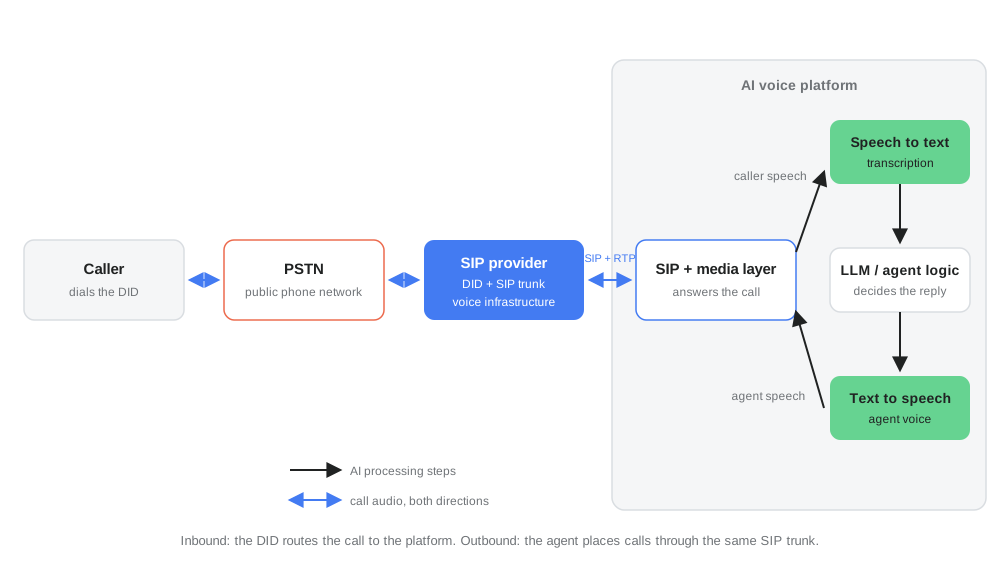
How an AI voice agent connects to the phone network: the DID and SIP trunk deliver the call to the platform’s SIP and media layer, which loops the audio through speech recognition, agent logic, and speech synthesis.
The same architecture serves an agent answering one number or thousands. Each DID is simply pointed at the platform’s endpoint, and the platform decides which agent configuration handles which number.
Outbound: agent-originated calls
For outbound use cases, the agent’s platform sends the INVITE: it originates a call through the SIP trunk, the carrier terminates it to the destination network, and the pipeline engages when the called person answers.
Outbound adds telecom considerations that inbound does not have:
- Caller ID. The displayed number should be a number you legitimately control, usually a DID on the same account, so recipients can call back and carriers can validate the traffic. Presenting numbers you are not authorized to use causes blocking and compliance problems.
- Answering machine detection (AMD). Outbound agents need to know whether a human or voicemail answered, because greeting a voicemail with a conversational opener wastes the call. AMD is a carrier or platform feature, not an LLM capability.
- Call pacing. Concurrency and calls-per-second limits on the trunk determine how fast a campaign or notification batch can run.
- Regulation. Rules on automated and recorded outbound calls, consent, and calling hours differ by country and are the operator’s responsibility. Verify the requirements for each market before launching outbound traffic.
Platform telephony vs BYOC
AI voice platforms typically offer two ways to get connected.
Platform-provided telephony. The platform resells numbers and minutes, and connectivity works out of the box. This is the fastest path for a prototype and often fine for early production in well-served countries.
Bring your own carrier (BYOC). The platform accepts a SIP trunk from a provider you choose, and your numbers and call routing stay with that provider. Teams move to BYOC when they need:
- Coverage in countries the platform’s built-in telephony does not serve, or where its numbers lack the right type (local, mobile, toll-free).
- Number ownership and portability. Numbers provisioned directly with a carrier survive a change of AI platform; the agent stack can be swapped while the numbers, and the customer-facing identity, stay put.
- Rates on significant call volume, particularly international termination.
- Existing numbers. Businesses adding an AI agent to numbers they already publish simply route those DIDs to the platform instead of re-provisioning everything.
- Compliance control. Regulated industries and markets with strict numbering rules often require a direct relationship with a licensed carrier.
Architecturally, BYOC just means the SIP trunk in the diagram terminates at your chosen provider rather than the platform’s default one. The signaling and media flows are identical.
Telecom details that matter more for AI agents than for humans
Codecs. The trunk and platform negotiate the audio format per call. G.711 is the universal baseline at 64 kbit/s narrowband; wideband codecs such as G.722 and Opus carry more of the speech spectrum. Cleaner, wider-band audio measurably helps speech recognition accuracy, so codec choice is worth deliberate attention rather than default acceptance.
Latency. Conversational turn latency is a sum: audio transport to the platform, speech recognition, LLM inference, speech synthesis, and transport back. The telecom leg is one component among several, and the way to keep it small is proximity: terminate the SIP and media as close as possible to where the AI pipeline runs, and choose a provider with points of presence near your platform’s region. No SIP configuration can compensate for a pipeline hosted a continent away from the media endpoint.
Interruptions (barge-in). Natural conversation requires the platform to detect the caller speaking over the agent and stop the synthesized audio quickly. This is an orchestration feature, but it depends on the media path delivering caller audio continuously with low jitter.
Transfer to a human. Most production agents need an escape hatch. The standard mechanisms are a SIP REFER, which asks the carrier to redirect the call to another destination, or bridging, where the platform dials the human on a second leg and joins the audio. Confirm which mechanism your platform and trunk provider both support before you design the escalation flow.
DTMF. Callers still press keys, and agents sometimes need to send tones to legacy IVRs. Touch-tone digits travel as special RTP payloads, and support must exist end to end.
Failover. If the platform endpoint is unreachable, calls to the agent’s numbers should go somewhere: a backup endpoint, a human queue, or a forwarding destination. Inbound failover is configured on the carrier side, which is exactly why it keeps working when the platform is what failed.
Common mistakes when connecting agents to the phone network
Assuming numbers exist everywhere. Number availability, types, and documentation requirements vary by country. A platform demo with one local number says nothing about provisioning numbers across the markets you plan to serve. Verify per country, early.
Treating latency as one number. Teams measure a slow agent and blame the network, or the model, without decomposing the turn. Measure transport, recognition, inference, and synthesis separately; they are fixed in completely different places.
Leaving no failover. An agent’s numbers that route only to a single platform endpoint become dead numbers during any platform incident.
Ignoring the human path. Escalation designed after launch tends to fail at the SIP level, because transfer support was never verified with the actual trunk configuration.
Confusing the layers commercially. The AI platform is not a carrier, and the carrier is not the conversation. When quality issues appear, knowing which side of the trunk a symptom belongs to shortens every support conversation.
Where didlogic fits
didlogic provides the telephony stack in this architecture. Its virtual phone numbers give AI agents reachable identities in over 130 countries, and its SIP trunking carries the calls between those numbers and the AI platform’s SIP endpoint, inbound through inbound SIP trunking and outbound to destinations worldwide. This is the bring-your-own-carrier model: didlogic supplies the numbers, routing, and call transport, and integrates with AI voice platforms including ElevenLabs and LiveKit.
The conversational side, including speech recognition, the language model, synthesis, and orchestration, remains with the AI platform. didlogic connects that platform to the public telephone network.
FAQs
Does an AI voice agent need a phone number?
For phone calls, yes. A DID gives the agent an address on the public network that people can dial and that can serve as its outbound caller ID. Agents that only handle web-based voice inside an app do not need one.
Can an AI agent transfer a call to a human?
Yes. The common mechanisms are SIP REFER, which redirects the call at the carrier level, and bridging, where the platform joins a second call leg to the human. Support depends on both the platform and the trunk configuration.
What is BYOC in AI voice?
Bring your own carrier: connecting a SIP trunk from your chosen provider to the AI platform instead of using the platform’s built-in telephony. Teams use it for country coverage, number ownership, rates, and compliance.
How much latency does the phone network add?
It depends on distance and routing between the caller, the carrier, and the platform’s media servers. Transport is one component of turn latency alongside speech recognition, model inference, and synthesis; keeping media termination geographically close to the AI pipeline is the main lever on the telecom side.
Which codec should an AI agent use?
G.711 is the universally compatible baseline. Wideband options such as G.722 or Opus improve audio fidelity, which helps recognition accuracy, when both the trunk and the platform support them.
Can I use my existing business numbers with an AI agent?
Usually yes. Numbers can be ported to, or already hosted with, a carrier that routes them to the AI platform, so the agent answers the numbers customers already know. Porting rules and timelines vary by country.
Do AI phone calls look different to the telephone network?
No. To the PSTN, a call answered by an AI platform is a normal SIP-terminated call. Regulatory obligations around automated calling still apply to the operator, but the network mechanics are standard.
